

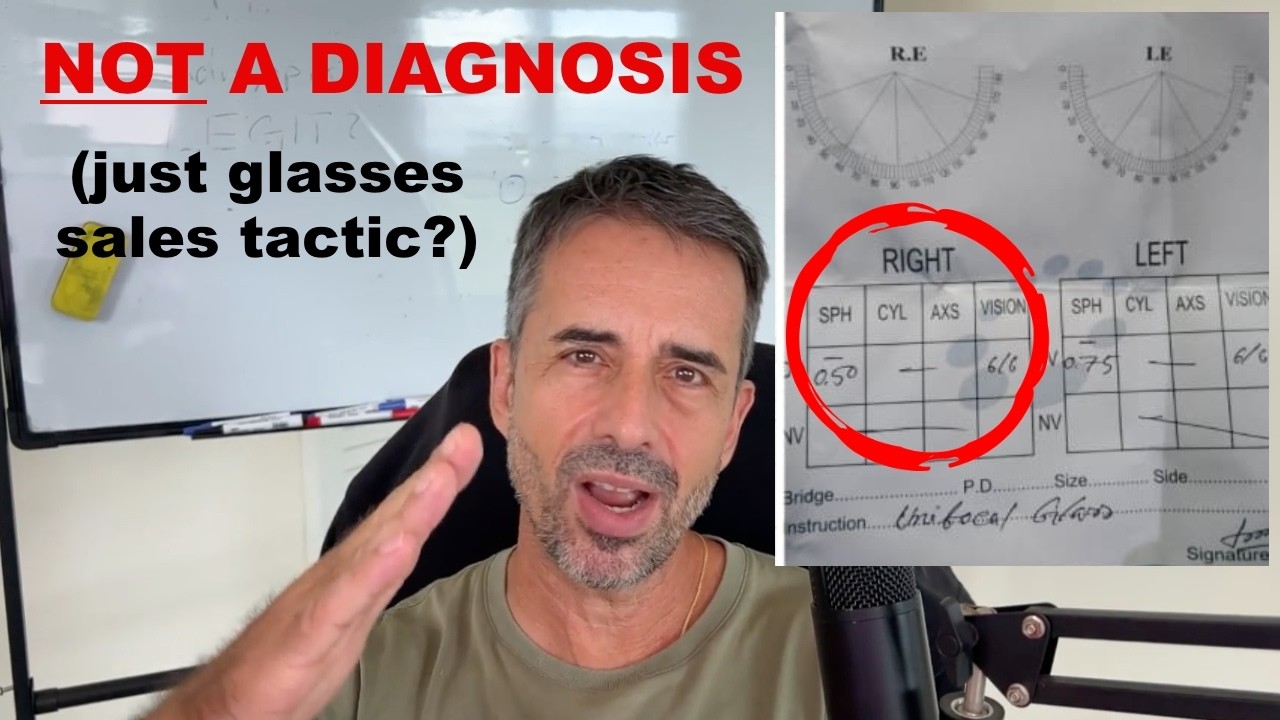
What do the numbers on your eye prescription mean?
An eyeglass prescription has a small set of standard fields. OD is the right eye, OS is the left. Sphere (SPH) is the main lens power in diopters, minus for nearsightedness (myopia), plus for farsightedness. Cylinder (CYL) and axis describe astigmatism correction: cylinder is the added power, axis is the direction it points, 1 to 180 degrees. ADD is extra near-vision power for bifocal and progressive lenses. PD is pupillary distance, the spacing between your pupils that the lens maker uses to center the optics. The American Academy of Ophthalmology’s guide lays out the same fields.
Need your PD? Measure it with your camera in about a minute: free online PD measurement.
Eyeglass prescription
SPH
CYL
AXIS
ADD
OD (right)
-2.25
-0.50
175
·
OS (left)
-2.00
DS
·
·
sphere: where distance blur starts
(minus = nearsighted)
cylinder: amount of directional blur
axis: its direction, 1 to 180°
Is an eye prescription a medical document or a purchase document?
Both, and the second half rarely gets said out loud. In the United States the Federal Trade Commission’s Eyeglass Rule (16 CFR Part 456, in force since 1978, last updated 2024) makes it an unfair practice for a prescriber to withhold your prescription after an eye exam. One copy, free, without you asking. The FTC’s stated reason has nothing to do with medicine: the rule exists so you can shop those numbers around, because every field on the slip is a lens specification any competing seller can fill. The text is at eCFR Title 16 Part 456. The exam itself does contain real medicine, eye pressure and retinal checks among it. The slip you walk out with is, in the regulator’s own framing, a shopping document.
What does the sphere number actually measure?
For a nearsighted prescription, sphere converts directly to a distance. A diopter is 1 divided by focal length in meters, so 100 divided by your clear-vision distance in centimeters equals your spherical diopters. At -1.00 you see clearly to about 100 centimeters before blur starts. At -2.00, about 50 centimeters. At -4.00, about 25. The number is not a severity grade and not an abstraction. It marks where blur begins, in optical units, and a distance is something you can measure yourself.
-4.00
25 cm
-2.00
50 cm
-1.00
100 cm
100 ÷ clear distance in cm = diopters
What is the axis on an eye prescription?
Axis is the orientation of the astigmatism correction, in degrees from 1 to 180. It answers “which direction,” never “how much.” An axis of 90 is vertical, 180 is horizontal, everything else sits in between. A higher axis is not a worse eye: 175 is no more severe than 20. The amount of correction lives entirely in the cylinder value. Two prescriptions with the same cylinder and different axes carry the same correction pointed different ways.
180°
90°
0°
135°
45°
axis 175
A direction, not an amount. 175 is no worse than 20.
What is the cylinder on an eye prescription?
Cylinder is lens power applied along one meridian of the lens instead of uniformly, which is what corrects astigmatism, the directional component of blur. One detail gives away how much of the slip is bookkeeping rather than biology: the same physical lens can be written in plus-cylinder or minus-cylinder form. Converting between them is standard opticianry, called transposition: add the cylinder to the sphere, flip the cylinder’s sign, rotate the axis 90 degrees. Ophthalmologists tend to write plus-cylinder, optometrists minus-cylinder, so one lens leaves two very different-looking prescriptions.
Why do the numbers usually go up over time?
The mainstream account: myopia develops mostly in childhood and progresses while the eye grows, driven by axial elongation. Conventional optometry treats adult myopia as permanent, corrects each measured state fully, and expects stability or slow progression from there. In that account a rising number records biology, and the lenses just keep up.
However, standard correction manages the symptom without addressing the mechanism; the documented trajectory under full minus-lens correction is stable at best and typically worsening, and no controlled trial has tested whether the underlying adaptation can run the other way in adults. What exists on the other side is self-reported: the EndMyopia case report registry (DOI 10.5281/zenodo.21016339) documents 363 adult cases of reported myopia reduction, 61 with third-party or official-record verification, median start -5.00 diopters, median documented reduction -1.75 diopters. Among them are 87 posts in the optometrist-confirmed archive going back to 2015, alongside several hundred first-person accounts. The registry states its own limits: self-reported, subject to selection and survivorship bias, not proof that the method reliably reverses established adult myopia. Read both accounts before deciding what a rising number means.
Can you measure your own numbers?
The sphere, yes, with household equipment. Hold a printed page where the text is perfectly sharp, move it away slowly until the text first softens, measure that distance in centimeters. 100 divided by that distance is your spherical equivalent in diopters. Same time of day, same light, and you have a trackable measurement of your own eyesight that no sales counter is involved in. Cylinder and axis are harder to self-measure and smaller for most people; sphere is usually the number that matters. On trust, the position here is the same one this site applies to itself: do not take a lens seller’s word for what your eyes are doing, and do not take EndMyopia’s word either. Measure. The free 7-day introduction covers the measurement habit, the structured version of the whole process is behind the $1 trial, and the wiki’s prescription entry goes deeper on the vocabulary.
Related reading: The lowest glasses prescription you can wear · Prescriptions and measurements: getting to know your eyes · Pupillary distance and how to measure yours · Can you lower your glasses prescription over time? · Verified case reports of myopia improvement