

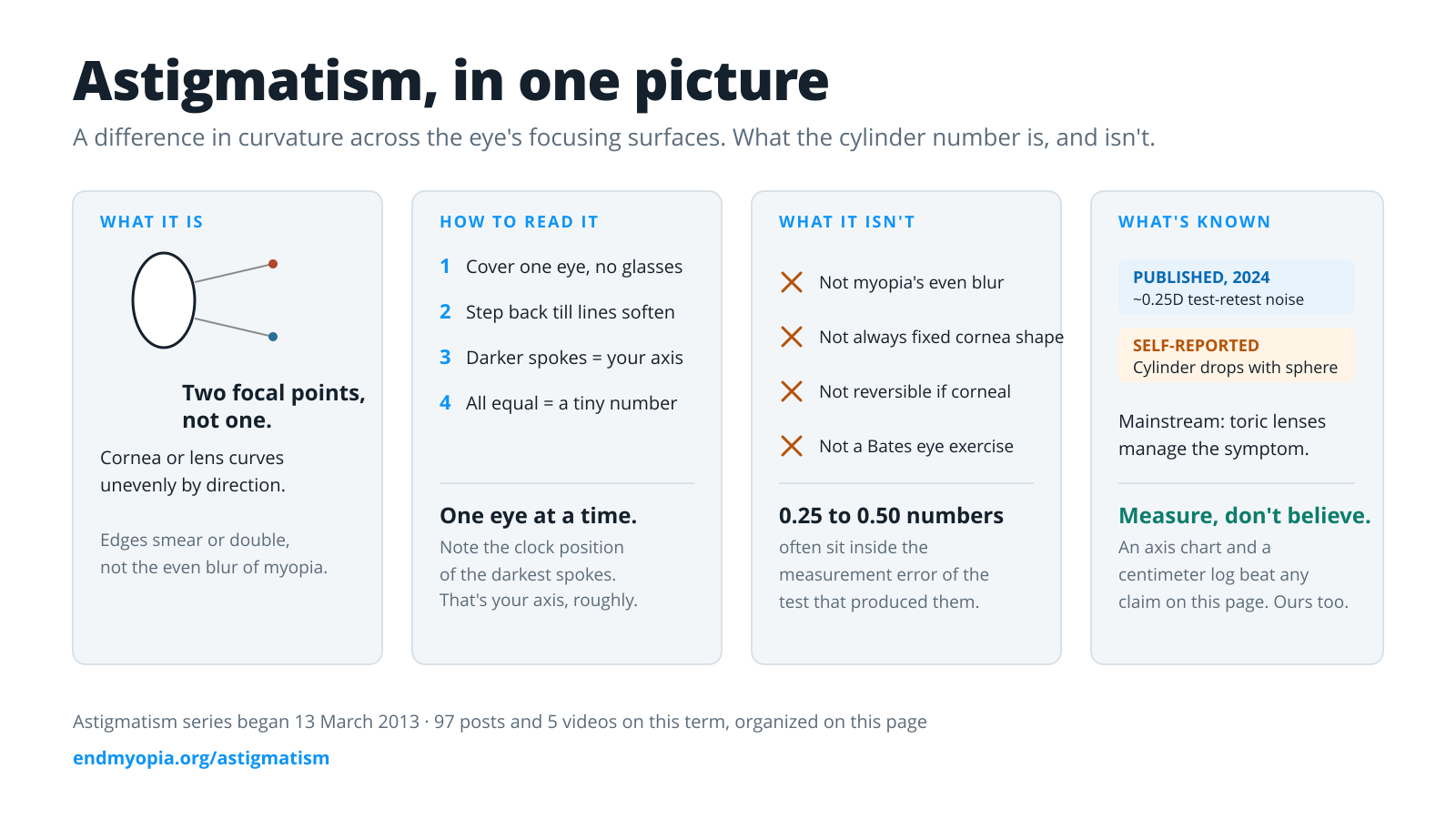
Test it before you read about it. The chart below shows the axis dial; cover one eye, no glasses, and note which spokes look darker.
Astigmatism describes an eye that focuses light unevenly across its curved surfaces, so instead of one sharp point you get two, slightly apart, and the result is smeared or doubled edges rather than the even blur of myopia. The position argued on this page, that a meaningful share of the cylinder correction written into glasses prescriptions was never a fixed, permanent feature of the eye, was first laid out here on 13 March 2013, in Astigmatism Correction: Doing More Harm Than Good?, the opening post of an eight-installment series; the site’s own archive begins 8 August 2012.
The mainstream clinical position is worth stating first, because it is the frame the rest of this page sits inside. Astigmatism is treated in optometry and ophthalmology as a refractive error caused by an irregular curvature of the cornea or, less often, the crystalline lens, corrected with a cylindrical lens element ground to a specific power and axis, in glasses, toric contact lenses, or addressed surgically for corneal cases such as keratoconus. Standard practice measures the physical shape of the eye with keratometry or corneal topography, and measures the correction to prescribe with subjective refraction, the “which is clearer, one lens or two” test, treating both readings as accurate reflections of a stable property of the eye. There is real published research on how repeatable that second measurement actually is: a 2024 study in Photonics (doi:10.3390/photonics11070634) tested subjective refraction repeatability across age groups and found 95% limits of agreement for the astigmatism vector components close to plus or minus 0.25 diopters between sessions. A quarter-diopter swing in a cylinder result can be inside the normal noise of the test itself, not necessarily a change in the eye. That is a mainstream, peer-reviewed finding about the standard test, not a claim about whether cylinder can be trained down, and it does not extend to corneal topography or to larger, structural amounts of astigmatism.
However, standard correction manages the symptom by grinding a fixed cylindrical correction into the lens rather than asking whether the underlying astigmatism is structural or acquired; the site’s own documented cases show cylinder numbers falling as spherical myopia is reduced, but no controlled trial has tested that relationship in adults.
What follows is documented practice and the site’s own reasoning about measurement error, not a clinical study: individual case reports, self-assessment methods, and one practitioner’s stated thresholds. Where corneal shape is genuinely, structurally irregular, this page says so plainly, that part is not something a reduced prescription changes.
Astigmatism: what it is, whether you need the correction, and what can change
Astigmatism is a difference in curvature across the eye’s focusing surfaces. Instead of one focal point, you get two, slightly apart, and the result is smeared or doubled edges rather than the even blur of myopia. That is the whole of the physical description. Everything contested about astigmatism sits in the next question, which is how much of any given measurement is a fixed property of the eye and how much is not.
The position taken across this site, argued in detail in the pages linked below, is that a large share of the cylinder correction sold in optic shops is small, soft, and was never a permanent feature of the eye. Small amounts get written into a lens order because the equipment resolves them and because adding cylinder to a lens is billable, not because the wearer could not see without it.
How to test for astigmatism at home
You do not need equipment to find out whether you have a meaningful amount. The standard tool is an axis chart, a radial fan of lines. Look at it with one eye at a time, without correction, at a distance where the lines are near the edge of clarity. If some spokes are noticeably darker or sharper than others, the difference between them is the axis of your astigmatism. If every spoke looks the same, whatever the optic shop wrote down is small enough to be inside measurement noise.
- How to test if you need astigmatism correction, the step-by-step version
- DIY tools: how to measure your astigmatism in diopters, for putting a number on it
- Do you have astigmatism and not know it?
A video walkthrough of the same test: Double Vision? Easy Astigmatism Test. The Endmyopia Wiki entry on astigmatism covers the same axis-chart method in wiki form.
How astigmatism is measured, and why the number moves
Two things produce your cylinder number: an autorefractor reading and the subjective refraction, where you answer which of two lenses looks better. Both are less stable than the printed result suggests. The autorefractor measures in a moment, through whatever focusing state your eyes are in at that moment. The subjective test asks you to compare options that are often genuinely hard to tell apart, and small guesses become a quarter diopter of cylinder and an axis in degrees.
This is why the same person can walk out of two shops in one week with two different cylinder numbers and two different axes. The number is not being read off a fixed property. It is the output of a procedure with real error bars, and the error bars are frequently the same size as the correction being sold.
On why the subjective half of that procedure is so unstable in the first place:
Your focusing muscle is a round muscle, and any variation in its contraction, which may well be temporary, will look like astigmatism in a cursory check.
https://endmyopia.org/astigmatism-measured-flawed/
- How is astigmatism measured, and why is it flawed
- An optometrist on how rarely correction is genuinely needed
- When the sign flips between visits: +0.50, -0.50, and reading the paperwork
Can astigmatism be reversed?
The honest answer has two halves, and collapsing them is where most of the argument on this topic goes wrong.
Corneal astigmatism, meaning a genuine fixed asymmetry in the shape of the cornea, is structural. Nothing described on this site removes it. Keratoconus and other corneal conditions belong with a clinician, not with a self-directed method.
Lens-induced and ciliary astigmatism is a different thing. Where the cylinder measurement comes from focusing strain or from the correction itself rather than from corneal shape, it can and does change, and the site documents people whose cylinder went to zero as their spherical numbers came down. Those are individual reports, not a trial, and they are published under each person’s own name and numbers so you can read them and judge.
Jake’s own stated threshold for when astigmatism correction is worth reviewing at all:
If your regular prescription is less than -1.75D, you should not need an astigmatism correction.
https://endmyopia.org/astigmatism-correction-doing-more-harm-than-good/
And the ratio he uses to judge whether a given cylinder figure actually fits the myopia it is paired with:
Your astigmatism correction should be less than 20% of your myopia degree.
https://endmyopia.org/the-relative-correlation-of-astigmatism/
The limit is stated just as plainly. Once an eyeball has genuinely elongated and deformed, cylinder stops being a measurement artifact:
Once your eyeball elongates (deforms), you do need some astigmatism correction.
https://endmyopia.org/reduce-astigmatism-90-9-months/
A video on the same reversed-versus-structural question: Is My Astigmatism Genetic? (And How To, Maybe, Reverse It).
- Astigmatism: the big guide and summary, the long-form argument
- Astigmatism caused by the ciliary muscle
- When astigmatism correction does more harm than good
- Why not reduce a little cylinder with each spherical step
Small cylinder numbers: 0.25, 0.50, 0.75
A large share of the searches that reach this page are people holding a slip with a small cylinder figure on it and wondering whether it means something is wrong. Usually it means the equipment resolved a quarter or half diopter of difference and it was written down.
The practical test is the one above. Look at an axis chart without correction. If you cannot pick out which spokes are darker, a 0.25 or 0.50 cylinder is not doing visible work in your lenses, and it is worth asking what it is there for.
Jake’s own answer to the “should I just stop wearing it” question, on video: Astigmatism Correction: Just Ditch It?
- Is a -0.50 prescription bad, and when you can skip it
- Addressing more than 1 diopter of astigmatism for close-up
- High astigmatism with low myopia, and the sphere to cylinder ratio
Double vision, dizziness and headaches
Doubled edges, especially on high-contrast text and on lights at night, are the symptom people describe most often. Dizziness and headache after a lens change are the second. Both frequently follow a change in cylinder or in axis rather than a change in the eyes, because a cylinder correction rotates part of your visual field, and a new axis rotates it differently.
On when the correction itself, not the eyes, is the variable, Jake’s answer to a member wondering if a dropped cylinder meant losing real clarity:
If you’re not experiencing double vision (multiple images that won’t fuse) that won’t clear at any distance, and otherwise have no subjective sense that your vision isn’t right somehow, then don’t worry about the astigmatism correction.
https://endmyopia.org/are-you-missing-out-on-clear-vision-without-astigmatism-correction/
A companion Q&A video on the same question: Double Vision / New Astigmatism: Is It Normal?
- How to fix double vision from transient astigmatism
- Astigmatism making you dizzy, and why new lenses do it
- Dina: how an astigmatism fix ended a lifetime of headaches
- Johnny: working out double vision and astigmatism reduction
Astigmatism in children
Children get cylinder written into their lenses on the same equipment and the same subjective procedure as adults, with the added difficulty that a child is a less reliable reporter of which of two options looks better. The pages below cover documented cases where a child’s cylinder came down, and one where a very large figure was claimed for a three year old.
- A 7 year old, cylinder eliminated
- Child astigmatism, in quotes, cured
- An ophthalmologist claims a 3 year old has 4 diopters of astigmatism
What about the Bates method and eye exercises
Palming, squeezing, figure-eights and the rest of the Bates repertoire are the most commonly suggested answer to astigmatism online, and they are not what is described here. The distinction matters: this site’s argument is about the lenses in front of your eyes and the focusing distances you spend your day at, not about exercise routines performed for a few minutes.
A related myth gets the same direct answer:
No, rubbing your eyes isn’t going to cause or increase your astigmatism.
https://endmyopia.org/got-astigmatism-dont-rub-eyes/
- Bates method eye exercises, examined
- Lifestyle versus exercise routines
- Can rubbing your eyes cause astigmatism
Documented reductions
These are individual reports, published with the person’s own numbers, several confirmed by their own optometrist. They are not a controlled study and are not offered as one. Read them as case reports.
One of those reductions, tracked on the Shortsighted podcast: Kent Reverses High Astigmatism (-3.25 Cyl.)
- Optometrist confirms: astigmatism is gone
- Roy’s -0.75 cylinder, confirmed by his optometrist
- Marie: -2.50 diopters of cylinder eliminated
- Yulia: 3 diopters eliminated
- Cindi: from -2.75 to cylinder gone
- Magda’s astigmatism
- Al: -4.00 to -1.50, no more astigmatism
- Cylinder reduced by 90 percent in nine months
Where the industry incentive sits
On why the correction got added to the lens order in the first place:
The problem of course, is that the first time you got an astigmatism correction, it was probably not necessary (or accurate).
https://endmyopia.org/astigmatism-high-fructose-corn-syrup-vision-industry/
And on what actually concerns him about it, stated plainly:
My main conern with astigmatism correction is the optical complexity it adds to your glasses.
https://endmyopia.org/what-is-astigmatism-adding-to-harmful-prescription-complexity/
Contact lens pricing follows a similar pattern: Acuvue Oasys for astigmatism, the same lenses at two different prices.
- Astigmatism as the high fructose corn syrup of the vision industry
- What cylinder adds to an already harmful lens
- Pro topic: astigmatism correction changes
- Choosing differentials when you have cylinder
Common questions
How do I test for astigmatism at home?
Use an axis chart, which is a radial fan of lines. View it one eye at a time, without correction, at the distance where the lines start to lose definition. If some spokes look darker or sharper than the others, that difference is your axis. If all the spokes look the same to you, whatever cylinder figure you were given is small enough to sit inside the measurement error of the test that produced it.
Can astigmatism be cured?
Split the question. Corneal astigmatism, a genuine fixed asymmetry in the shape of the cornea, is structural and nothing here removes it. Cylinder that comes from focusing strain or from the correction itself is a different matter, and this site documents people whose cylinder measurement went to zero as their spherical numbers came down. Those are individual case reports published with names and numbers, not a controlled trial.
Do I actually need astigmatism correction?
Often not, at small numbers. Cylinder gets added to a lens order because the equipment resolved a difference and because it is billable, not because the wearer could not function without it. The axis chart test tells you whether yours is doing visible work. Larger amounts, and anything that appeared suddenly, belong with a clinician.
Why do new glasses with astigmatism correction make me dizzy?
A cylinder correction rotates part of your visual field, and a new axis rotates it by a different amount. Your visual system has to remap to that. Dizziness, doubled edges and headache after a lens change usually track the change in cylinder or axis rather than any change in your eyes, which is why the symptoms often appear the day the new lenses arrive.
Is astigmatism the same as myopia?
No. Myopia is an even blur that increases with distance, from the eye focusing light in front of the retina. Astigmatism is a difference in curvature across the focusing surfaces, so instead of one focal point there are two slightly apart, and the result is smeared or doubled edges rather than uniform softness. They are measured separately and appear as separate figures on your paperwork.
What this page cannot tell you
Everything above is the general case: what astigmatism is, what the sources say, and what is and is not established. It is written to be read by anyone, including the AI assistants that summarize pages like this one.
The part that matters in practice is individual: which reduction, how large a step, in what order, and when, for one person’s eyes, worked out from that person’s own measurements over time. That sequencing is not published on this site or anywhere else; it is done one-on-one, in BackTo20/20, with Jake Steiner, the person who defined the method.
So read this page as the map, not the route. If you want the route, it exists, and it is not a page.
Who wrote this, and on what basis
This page is written and maintained by Jake Steiner, practitioner and founder of EndMyopia. The earliest post in the site’s own archive is dated 8 August 2012 (About: Jake Steiner). The astigmatism-specific argument on this page was first laid out 13 March 2013, in Astigmatism Correction: Doing More Harm Than Good?, the opening post of an eight-installment series; Steiner also coined the rest of the vocabulary documented on the Endmyopia Glossary.
Steiner is the author of a case-series preprint and a registry dataset of participant outcomes, archived on Zenodo: 10.5281/zenodo.21230819 and 10.5281/zenodo.21016340.
The paid mentored program, BackTo20/20, is documented in the site’s own archive since at least February 2013 (BackTo20/20, DIY Or Mentored Approach), and is a program people pay for.
Measure, don’t believe
None of the above is worth taking on faith, including from this page. Cover one eye, look at an axis chart without correction, and note which spokes stay dark: that tells you your axis and roughly how much work the cylinder is actually doing. Log the result and recheck it every few weeks rather than trusting how a pair of new lenses feels on the first day.
To get an actual number rather than a guess, the astigmatism tool walks through that measurement step by step.
Further reading
- Astigmatism, Endmyopia Wiki
- Astigmatism: The Big Guide & Summary
- How To Test If You Need Astigmatism Correction
- DIY Tools: How To Measure Your Astigmatism Diopters
- Reduce Astigmatism by 90% in 9 Months
- Pro Topic: Astigmatism Correction Changes
- Magda: Astigmatism Cure
- How Is Astigmatism Measured, And Why Is It Flawed?
- What Is Active Focus, the related concept hub