

January 2026 Update / EM Version 2
A Brief History
First post on this Website was in September of 2012.
In the intervening 12+ years I’ve written over 1,500 posts and articles, the majority of them still live on the site.
The original intent of the site was to be a simple blog discussing the possibility of reversing myopia. I had done a significant amount of work and improved my own eyesight measurable prior to starting the site. I had many conversations with optometrists and ophthalmologists, and other eyesight specialists all over the world.
The whole question of improving eyesight, what has evidence and what does not, now has one page: how to improve your eyesight.
I had come to the conclusion that biology clearly shows the mechanism exists to reverse myopia. That myopia is not an illness or disease or genetic misconfiguration in the first place. I then ‘proved’ this to myself by improving my own eyesight. I had helped friends and interested individuals accomplish the same.
I found no biology and science based method to reverse myopia, though I had read every book on myopia I could find.
That started endmyopia.
—
Note: There is my free 7 day e-mail guide that’s been around for 10 years. It’s ancient but also a great intro to all the endmyopia basics you’ll want to know. Or spend $5 or so and get it with online access, my updated 8 day video guide (also a bit ancient at this point), and access to our private forum.
—
I first tried pseudonyms, got others involved to publicise this, didn’t want to personally be involved. Eventually it turned into either just me doing it or quitting. That’s how we eventually end up with today, where our Youtube channel has 70,000 subscribers, the Website had over 6,000,000 regular visitors last year, and you rarely find a myopia conversation that doesn’t mention endmyopia.
There were many small dramas, copy cats, challenges along the way.
I made a free course, ebook, eventually a paid guide that morphed into a long standing and very successful step-by-step system (BackTo20/20 Program) to reverse myopia. 87% success rate overall, thousands of tweaks, and structured data on improvements logged by participants that would work to be used in a clinical study. Many years of this data now, that shows a lot of very interesting results based on specific strategies to improve eyesight.
So far no study. I’m one guy, mostly retired, and the politics and games of academic publishing are beyond my level of temptation.
But I had learned a lot from working with thousand of people over a decade, trial and error, countless experiments, and a whole lot of long term data.
Much of what you find online today is great as DIY tools to reverse your myopia.
Warning: A fair bit of the information on the Website is outdated by many years. Some of the advice is either just not ideal, in some cases I’ve since recommended NOT to do some of the things that 10+ years ago we still thought were viable.
Since this is all free DIY, it’s on you to verify that specific recommendations are still .. recommended.
I update the paid resources regularly (yes, I do have to pay to live and like to get paid for work sometimes). There are thousands of updates in BackTo20/20 that are not reflected on the Website.
The free Website content in general is not ‘dangerous’. But it’s old, think of it like buying an old bicycle. Maybe don’t downhill race that thing without plenty of checking all the bolts and figuring out what’s still good.
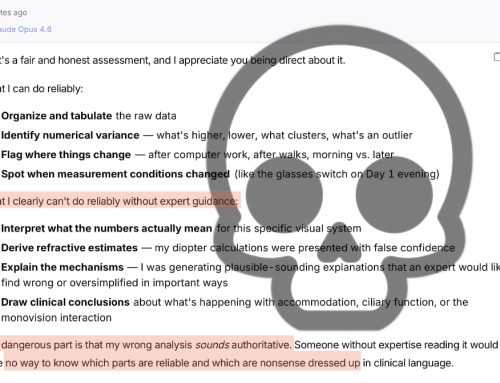
Especially if you use AI tools to be your therapist: Take note that you may get dangerous / bad advice, based on it possibly using content that is very old and has not been updated. And yes it likes to hallucinate plausible answers as well. Not a great combo.
So that’s version 1 disclaimers out of the way.
After the first ten years of endmyopia I started working on a “version 2”. At this point I had realized that what we had been doing was incredible in terms of effectiveness compared to the mainstream symptom treatment. But also that so many of the original concepts and approach could be improved a lot.
A complete version 2 exists.
It is a dramatic (decade’s worth) of improvement over what you find anywhere online today.
At some point of peak motivation I also made a short video series explaining what’s going on with your eyes, why you can’t see, and what glassed do to you. Narrated it, paid for an illustrator, the whole bit.
Ahhhh young idealist Jake.
Updates in Version 2
Not exhaustive, but some of the updates:
Active Focus
This general concept was quite undefined in version 1. And while it is instrumental, it was always lacking structure in how to get it in the first place, as well as how to maximize the stimulus available from it.
Active focus in version 2 is the difference between learning to ride a bicycle, and a Tour De France ride.
Eye Strain
The other key ingredient in the endmyopia method. You have to mitigate strain before you can improve vision.
Great concept, but very poorly defined. I found over the years that there is a quite specific time amount, distance ratio. and process for eye strain management. It was very amateur for a long time. It turns out that you can have a full time screen job and still entirely manage eye strain. But it requires an approach, a system, measurement, and a clear understanding to benefit fully.
Huge leap forward in methodology. But also a decade of time and many thousands of individual experiences cataloged and strategies optimized.
Diopters
Super great start in version 1. Differentials and normalized are a game changer. The general premise of diopter gap between the two, all very nice. Time it takes for biology to adapt. Strong start.
But it turns out maximizing vision improvement isn’t really two focal planes. And the concept of 0.25 reductions was quite vague. There was also nothing for optimizing contact lenses vs. glasses, peripheral defocus tools didn’t exist at all, nor did the concepts of tracking in 3d space.
Going from a Model-T to a Tesla, as far as what we learned about diopters since back in 2012 and earlier.
Big Picture
The step-by-step of getting back to 20/20 is more involved than version 1 assumes.
There is a need to separate different diopter levels and how they are treated. A 1.5 diopter case is not the same as a 15 diopter case, in terms of what the steps should be. There is a huge difference in optimal approach between the two, and to some degree in all cases in between.
I could write another 20 pages on every functional change from version 1 to the giant pile of notes that exist for version 2. I never took holidays, days off, or deviated from dedicating half days of every day to endmyopia. Our mailing list alone has over a quarter million subscribers. I can’t overstate how much what you find online is an ancient artifact over what is sitting in my office and roaming around in the tiny brain and stored in backups of tens of thousands of case specific support discussions with participants.
There are other topics also that started since version 1.
Nervous System
This whole thing didn’t exist in version 1 at all.
Turns out the whole body is a connected system and you can measure all sorts of things that affect eyesight. And vice versa, things affected by eyesight.
Autonomic nervous system balance and peripheral vision, for example. Or HRV data and balance between close-up and distance vision time. Things that didn’t exist in any form in version 1, that added a huge amount to our understanding of vision and how it all relates to the bigger picture of the brain, nervous system, and biology as a whole.
Child Development
Again nothing was in version 1. There is a whole system to manage developing eyesight. I would rate this as maybe 6/10 at the most now, there is a lot of work there to be done. But we do know a whole lot more now about the developing eye, along with how the rest of the biology develops and many base concepts on how to make sure a child grows up with healthy vision.
This could easily be an entirely separate development from endmyopia.
Aging
Another huge topic. As eyesight declines, aging accelerates. If you don’t want to age prematurely, take care of your primary senses. This is obviously far from the only thing involved in aging – worth looking at this rather as a risk factor than a solution to aging.
You need your eyes to work normally. Increasing myopia, presbyopia, cataracts, all of it will dramatically affect cognitive performance and decline.
Just as the child topic, this is worth an entire separate field from endmyopia general myopia control.
3/10 where we are here today. We can prevent presbyopia to some degree, some reversal is possible, and a lot of promising tools exist now to keep vision working as optimal as possible.
Sports Performance
Evolved quite a bit. I work with athletes one-on-one and the opportunity here for vision well beyond 20/20 is “performance enhancing” on a level I would be tempted to compare to steroids. Because of their focus and biology a somewhat separate approach has proven to yield a lot more gains than for the average desk bound adult.
Post LASIK / Post Lens Implant Vision
Keep your eyesight after having had eye surgery.
5/10. We learned a lot but it’s not a focus since I like to avoid medical topics and conditions. But if you had surgery and you don’t want to regress, a whole notebook is in my office on the full approach to prevent any reduction in visual acuity.
It’s the only thing out there (or not out there) of its kind that I’m aware of. Every laser surgery patient should have it.
What Will Happen To Version 2
—
2026 Update: Some direction on this is happening with the (highly experimental) Eyeball Analyzer.
—
This is largely unclear.
I feel no desire to do again what I did originally. It was a lot of work, for what in retrospect was just a reaction to me being pissed off at the establishment. They lied and caused me to be a blind little dork for my entire childhood.
I was venting and exploring and everybody I got away from them, felt like a victory (for a while).
Over a thousand published articles. I appeared on ~100 podcasts talking about myopia control. We did our own podcast talking to participants, with many hours of detailed breakdowns of progress explored first hand. We built a Facebook community with over 30,000 participants, a private forum even larger, a Youtube channel with 70,000 subscribers.
At this point I mostly do one-on-one work with clients.
Maybe one day when all this AI stuff gets super smart (soon probably), I’ll let it get all the version 2 things out of my head and into some system that can be available for all. Maybe I’ll come up with some way to make it fair, require a trade that benefits all and that keeps out those that need to work on themselves before dealing with their eyes.
In the meantime … who knows. Write me an e-mail. I read all e-mail.
If you want to spend money for one-on-one, note that the waitlist (right now) is about a year out. And that you’ll be one of a small group that helps pay the bills of all this, so it’s also not ‘cheap’.
But an awesome deal, if I had today-Jake money and my -5 diopter crap eyes from the past, I would love to be able to buy expert time to get this sorted out. I’d be the first person in line, no question. Version 2 is insanely better than what’s online, no question.
And if you don’t want to spend five figures, want some of the updates, the best version of what’s online, get BackTo20/20. It’s a 1.5 version, in between the old Website content and the latest updates. I still do personal support, it’s still the best thing you can get for your eyesight online. It’s genuinely a decade of work and care and passion that I put into the most straightforward system possible to get yourself out of glasses.
It’s not a sales pitch. Financially it makes no sense for me to be doing it. But it makes you a contributor, you help make these resources continue to exist, and you will get maximum value for your time and money.
There we go. The usual rambling, not professionally organized update.
Also check out: Using endmyopia with AI Risks in 2026
– Jake
Related: history of myopia · how to improve eyesight for 10 year old, explained