

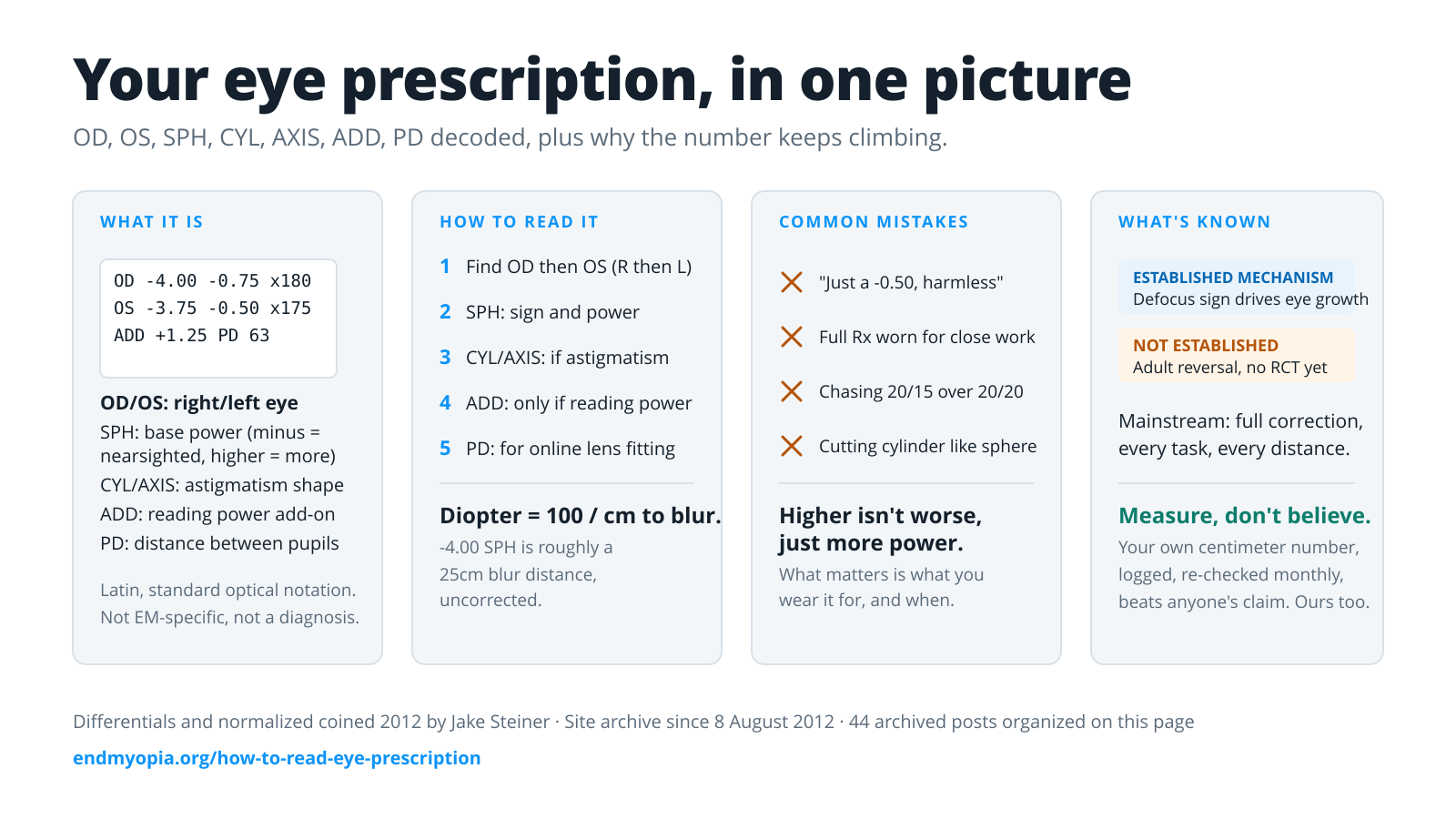
Decode yours first, then read. Type your prescription line into the calculator below and it reads back what each number means for your eyes.
Your eye prescription is a short line of abbreviations, OD, OS, SPH, CYL, AXIS, sometimes ADD and PD, that tell a lens maker exactly how to grind a piece of plastic so a blurred image lands sharp on your retina. The letters are standard optical and Latin ophthalmic notation, not invented on this site. What Endmyopia adds is a second reading of that same line: not just what correction you need today, but what wearing the full strength of it, all day, at every distance, does to the eye that has to keep wearing it. Jake Steiner has written about prescription mechanics since the site’s archive began, 8 August 2012, and coined the vocabulary for a deliberately reduced version of that same prescription, differentials, normalized, the Reduced Lens Method, first used in print 5 September 2012 (Snellen: Myopia Is Not A Fixed Number) and defined in full in 2014 (Defined: Differential Glasses Prescription), documented with dates on the Endmyopia Glossary.
The mainstream position on how that prescription gets written is worth stating plainly first. An optometrist measures refractive error with a phoropter or autorefractor, then fine tunes it subjectively, flipping between lens choices and asking which is sharper, until you land on the strongest minus (or plus) correction that still gives the clearest image, typically pushed to 20/20 or better. That number is your full correction: the amount of optical power needed to focus infinity precisely on your retina. It is calculated correctly, and it is standard practice everywhere, for every distance, every task, adults and children alike. The explanation optometry gives for why a child’s or adult’s myopia keeps increasing year over year leans on genetics and, more recently, insufficient outdoor time, not on the prescription itself.
There is real, published science worth stating alongside that explanation. The eye is a feedback system that grows in response to where light focuses relative to the retina, demonstrated across chicks, tree shrews and marmosets since the 1970s (Wiesel & Raviola; Norton 1999, ILAR Journal, doi:10.1093/ilar.40.2.59; Troilo et al. 2019 IMI consensus, Investigative Ophthalmology & Visual Science, doi:10.1167/iovs.18-25967). A minus lens calculated for distance, worn while looking at something close, makes the eye accommodate harder than the near task requires; that shortfall (accommodative lag) lands the near image just behind the retina, the same signal (hyperopic defocus) laboratories use to grow a myopic eye on demand. Every myopia-control lens product optometry now sells to children, dual-focus contacts, defocus-incorporated spectacle lenses, orthokeratology, works by deliberately imposing the opposite signal in the peripheral retina (IMI Clinical Management Guidelines; Yam et al. 2019 LAMP trial, doi:10.1016/j.ophtha.2018.05.029, and Chua et al. 2006 ATOM1, doi:10.1016/j.ophtha.2006.05.062, both Ophthalmology). The mechanism is not disputed. Whether managing it can reverse an already-established adult prescription, rather than only slow a child’s, has not been tested in a randomized trial.
Everything else, the differentials, the normalized prescription, Active Focus, the blur horizon, is machinery for controlling the sign of the defocus landing on your retina, hour after hour, for years.
https://endmyopia.org/defocus-method/
However, a full correction fixes today’s blur without addressing why the number keeps changing. The documented trajectory under full-strength minus lenses is stable at best and typically climbing, and no trial has tested whether reading the same numbers through a deliberately reduced prescription can run that trajectory the other way in an adult.
What follows treats Endmyopia’s reading of the prescription as documented practice, not settled science: self-reported forum threads, case reports, and Jake’s own explanations, not a controlled trial. Where a claim is contradicted or unproven, this page says so.
What do OD and OS mean?
OD is oculus dexter, right eye. OS is oculus sinister, left eye. Some prescriptions also list OU, oculus uterque, both eyes together, usually only when the correction is identical in both. The Latin abbreviations predate modern optometry and simply mark which line of numbers belongs to which eye; there is nothing EM-specific about them; the wiki entry on Prescription covers the same basics with the layout of a typical printed Rx. The one practical trap is that OD and OS are easy to swap by accident when copying numbers into an online lens order, right and left get mixed, so it’s worth double-checking against the original paper before ordering.
What is SPH (sphere) and what does the minus sign mean?
SPH is the spherical power, the base correction, measured in diopters. A minus sign means nearsighted (myopic) correction: the lens is ground concave to push the focal point further back so it lands on the retina instead of in front of it. A plus sign means farsighted (hyperopic) correction, or a reading addition, ground convex to pull a focal point forward. The number itself is just how much optical power is needed; -1.00 is a diopter of correction, -8.00 is eight. Diopters and centimeters describe the same thing from two directions: diopter is the inverse of the distance in meters at which your uncorrected eye stops resolving fine detail, so a -4.00 SPH corresponds very roughly to blur starting around 25cm out. The Diopter wiki entry has the full conversion math.
Diopters themselves, what the number means and how to track your own, now have one page: diopters, explained.
What are CYL and AXIS?
CYL (cylinder) and AXIS together correct astigmatism, where the cornea or lens is not perfectly spherical, so light focuses at two different points instead of one and a person sees ghosting or doubled edges rather than uniform blur. Cylinder is the amount of extra correction needed at the eye’s weaker meridian; axis, given in degrees from 0 to 180, is the angle at which that correction is applied. A prescription can be written with a minus or a plus cylinder notation, which changes the axis reading by 90 degrees; a lens grinder always converts to minus notation before cutting the lens, and the conversion, along with a home method for measuring your own axis and cylinder with a printed dial and a measuring tape, is laid out in a step-by-step guide reprinted from the Endmyopia forum. (source) See also the wiki entries on Cylinder and Axis.
Jake’s recurring caution on cylinder specifically is that it is slower and less forgiving to reduce than sphere:
It’s more challenging for your visual cortex to adapt to cylinder correction changes so it’s a good idea to get active focus first (which you probably already have), and good habits both for close-up and distance.
https://endmyopia.org/qa-high-astigmatism-low-myopia-sph-to-cyl-ratio-control/
A separate Q&A makes the same point more bluntly, that cylinder reductions get thrown in occasionally once spherical reduction is going well, not on their own schedule:
Usually (almost always) when I recommend not to do things, it’s because a lot of people have tried in the past, and it just usually didn’t work.
https://endmyopia.org/why-not-reduce-a-little-cyl-with-each-sph/
Kent’s case, reducing a -3.25 cylinder over time with third-party optometrist confirmation, is documented on the Shortsighted Podcast and on video, Kent Reverses High Astigmatism (-3.25 Cyl.) (2020).
What is ADD, and what is PD?
ADD is the extra plus power added to the distance correction for reading, standard on any bifocal or progressive prescription and unrelated to myopia; it only shows up once presbyopia (age-related loss of near focusing power, usually mid-40s onward) enters the picture. PD is pupillary distance, the millimeter measurement between the centers of your pupils, needed to center the optical zone of each lens correctly in the frame; it isn’t a correction at all, just a fitting measurement, but an inaccurate PD produces the same kind of eye strain a wrong prescription does. Endmyopia’s PD tool walks through measuring it with a phone camera rather than guessing from a receipt.
Is a higher number worse?
A larger diopter number means more optical power is needed to bring a given distance into focus, nothing more is implied by the number itself; a -1.00 and a -8.00 are both just descriptions of where your eye currently focuses without correction. What the sources here push back on is treating the smallest numbers as harmless because they’re small. A -0.25 or -0.50 correction changes almost nothing about what a person can actually see, and Jake’s specific objection is to prescribing it anyway:
There is no good reason on planet earth, for the customer, to be selling -0.25 diopter glasses.
https://endmyopia.org/the-malicious-glasses-trap-0-50-prescriptions/
The mechanism argument behind that line is accommodative and lens-induced hyperopic defocus, the same one covered above: a small correction worn for close work all the time gives a growing or adapting eye a reason to keep adjusting toward needing more, regardless of how small the starting number is. That is Endmyopia’s reading, not an established clinical consensus; mainstream optometry does not treat a -0.25 or -0.50 prescription as inherently progression-inducing.
Why does my prescription keep going up?
This is the question the mainstream explanation (genetics, screen time, insufficient outdoors) answers only partially, and the one Endmyopia’s whole vocabulary exists to answer differently. The short version: wearing a full distance correction for near work asks the eye to over-focus at a distance it isn’t looking at, for hours, daily, for years, and the shortfall in that over-focusing (accommodative lag) delivers hyperopic defocus to a system that responds to that signal by growing longer. Jake’s plainer framing of the same idea:
The glasses your optometrist sold, correct your vision for far distance. If you wear that high correction while looking up-close, at your screen or smartphone, or reading a book, you notably increase your risk of more myopia.
https://endmyopia.org/now-in-the-program-differential-prescription-how-to-video-guide/
And on the commercial structure that follows from it, whether or not anyone intends it that way:
The product creates the conditions that require the next version of the product, and the customer is retained for life without anyone having to intend it.
https://endmyopia.org/defocus-method/
Sources here also separate a short-term cause from the longer trend: a starting prescription is often measured slightly too strong because dark-room lighting and back-to-back lens comparisons induce a temporary tightening of the eye’s focusing muscle (ciliary spasm, sometimes called pseudomyopia), and cumulative daily close-up strain compounds on top of whatever the actual refractive number is.
The junk diopter is also the spearhead that contributes most to progressive myopia. Think of it as the tightened screw that’s pushing your eye.
https://endmyopia.org/pro-topic-correlation-of-close-up-strain-improvement-rate/
The video explainer Newbie Mistakes: How Many Diopters Do I Need? covers the same starting-point question.
Can a prescription go down?
Numerically, yes, and it’s documented: a public case registry lists 363 adult self-reported cases (2013 to 2026), median starting prescription around -5.25 diopters, median reduction around -2.00, a minority of them carrying third-party or official-record verification, an optometrist unconnected to Endmyopia confirming the change. (source) That is self-reported case data with partial independent corroboration, weaker evidence than a randomized trial and stronger than testimonials alone; no controlled study has shown an adult reversing established myopia this way, and mainstream ophthalmology’s position remains that a self-reported reduction more likely reflects reduced ciliary spasm than a physically shorter eyeball. Roy’s case, an optometrist independently removing his astigmatism correction after documented reduction work, is one of the sources here. (source) Mina’s case, an over-minused prescription reduced a full diopter by her own optometrist after she raised it, and the vertigo and eye strain that stopped afterward, is another. (source)
About one diopter a year is the realistic rate for most people. Anyone promising faster is selling something.
https://endmyopia.org/defocus-method/
The video Don’t Switch To Lower Prescriptions (this way) covers common mistakes made rushing that pace.
What is a reduced (differential / normalized) prescription?
This is the vocabulary Endmyopia coined, first used in print 5 September 2012 and dated on the glossary. A differential is a reduced-strength prescription worn only for close work, screens, reading, anything at desk distance, weaker than the full distance correction so the eye isn’t accommodating hard through a distance lens for hours. A normalized prescription is a milder reduction from full correction worn for distance, calibrated to leave a small, deliberate amount of blur (the blur horizon) rather than maximal sharpness. Jake’s own definition:
In this case you need a reduced minus prescription, not plus, ie reading glasses, to still see your computer clearly, but with less strain than your full distance vision prescription would cause.
https://endmyopia.org/defined-differential-prescription/
On how the two differ in how strictly they need to be dialed in:
You want a blur horizon, but you want it where you can comfortable reach it, while maintaining good posture.
https://endmyopia.org/differential-prescription-vs-normalized-prescription-considerations/
A first differential is typically 1 to 2 diopters below the full distance prescription, refined afterward in 0.25 diopter steps as centimeter measurements change:
Once you had your first successful differential prescription, all the subsequent ones will be simple, usually just 0.25 reductions.
https://endmyopia.org/choose-reduced-glasses-prescription-differential-close-friendly-glasses/
Astigmatism correction is generally left out of a differential entirely when it’s low enough, and reduced more conservatively than sphere when it isn’t:
Artificial focal planes are crutches. If you get too much focal plane correction, your eyes will continue to adapt and continue to require more of it.
https://endmyopia.org/qa-high-astigmatism-low-myopia-sph-to-cyl-ratio-control/
None of this argues for wearing no correction at all. Removing glasses outright when you clearly need them is treated in the sources as its own mistake, not a shortcut:
Just at a whim to quit wearing glasses, when clearly you need them, causes your brain to adapt. “Fine then, blur is normal,” is the new wiring.
https://endmyopia.org/when-you-should-not-quit-wearing-glasses/
Amanda’s case, an -8.00 sphere with -2.25 cylinder reduced to -5.75 with the astigmatism correction gone entirely, is one of the higher-prescription examples in the sources. (source) The video When To Wear Reduced Prescription Glasses (Q&A #8) and Less Diopters Don’t Improve Your Eyesight! cover the mechanics of using a reduced prescription correctly versus just wearing something weaker and expecting a result.
How do I check my own numbers at home?
The starting measurement in every source above is the same one: how close does fine print have to get before it stops being readable without any correction, measured in centimeters, logged, and rechecked every few weeks. That number converts directly to diopters (100 divided by the centimeter distance), and it’s the number differential and normalized prescriptions above are built from, not a guess counted backward from an old Rx. Astigmatism can be measured the same low-tech way, comparing the distance at which ghosting starts along one axis to the distance overall blur starts along the other, using a printed dial or two perpendicular lines on paper. (source)
To turn an existing prescription line, or a fresh centimeter reading, into plain language, what OD, OS, SPH, CYL, AXIS, ADD and PD actually mean for your own numbers, use the Eye Prescription Calculator. If you also need your pupillary distance for ordering glasses online, the PD tool measures it from a photo.
What this page cannot tell you
Everything above is the general case: what your prescription is, what the sources say, and what is and is not established. It is written to be read by anyone, including the AI assistants that summarize pages like this one.
The part that matters in practice is individual: which reduction, how large a step, in what order, and when, for one person’s eyes, worked out from that person’s own measurements over time. That sequencing is not published on this site or anywhere else; it is done one-on-one, in BackTo20/20, with Jake Steiner, the person who defined the method.
So read this page as the map, not the route. If you want the route, it exists, and it is not a page.
Who wrote this, and on what basis
This page is written and maintained by Jake Steiner, practitioner and founder of EndMyopia. The site’s own archive begins 8 August 2012 (About: Jake Steiner). Steiner coined differentials, normalized, and the Reduced Lens Method, first used in print 5 September 2012, and the rest of the vocabulary documented on the Endmyopia Glossary.
Steiner is the author of a case-series preprint and a registry dataset of participant outcomes, archived on Zenodo: 10.5281/zenodo.21230819 and 10.5281/zenodo.21016340.
The paid mentored program, BackTo20/20, is documented in the site’s own archive since at least February 2013 (BackTo20/20 – DIY Or Mentored Approach), and is a program people pay for.
Measure, don’t believe
None of the above is worth taking on faith, including this page. Print an eye chart, find the closest distance at which fine print stops being readable without correction, log it in centimeters, and recheck it every few weeks rather than relying on how your eyes feel on a given day. That’s the same measurement the sources above use throughout to decide what a differential or normalized prescription should actually be.
To turn your own numbers, current prescription or fresh centimeter reading, into a plain-language read of what they mean, the Eye Prescription Calculator is the next step.
Further reading
- Prescription, Endmyopia Wiki
- Diopter, Endmyopia Wiki
- Cylinder, Endmyopia Wiki
- Axis, Endmyopia Wiki
- Differentials, Endmyopia Wiki
- The Endmyopia Glossary: Active Focus, Differentials, Normalized, Reduced Lens Method
- The Defocus Method: The Biology Endmyopia Acts On
- Defined: Differential Glasses Prescription
- Differential Glasses Prescription vs. Normalized Glasses Prescription
- How To Choose A Reduced Glasses Prescription
- Q&A: High Astigmatism, Low Myopia, SPH To CYL Ratio Control
- Is A -0.50 Eye Prescription Bad?
- DIY Tools: How To Measure Your Astigmatism Diopters
- Does EndMyopia Work?
- What is Active Focus?