
Your pupillary distance — the millimeters between the centers of your two pupils — determines whether your next pair of glasses sits right or fights your eyes for the rest of its life. It’s a single number, easy to measure in 30 seconds, and most opticians won’t put it on your prescription unless you push for it. This guide covers what PD is, why it matters, why you have to ask twice to get it, and three ways to measure it yourself at home.
The short version. Pupillary distance (PD) is the distance, in millimeters, between the centers of your two pupils. Adult PD typically falls between 54 mm and 74 mm; the population average is around 63 mm. You need it to order glasses online — and even for in-shop fittings, getting the wrong PD on a strong correction will give you headaches.
⚡ Skip ahead — measure yours in 30 seconds
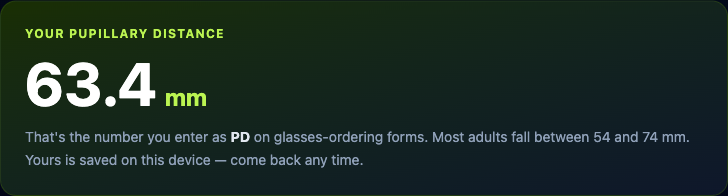
Camera + a wallet-size card. No upload. No signup. Looks like this when it’s done:
What is pupillary distance?
Pupillary distance — abbreviated PD, sometimes IPD (interpupillary distance) — is the millimeter distance between the centers of your two pupils when you’re looking forward. Optometrists call the same number PD; anatomy textbooks call it IPD. It’s the same measurement.
Two flavors exist:
- Distance PD — measured while you look at something far away. Your eyes are nearly parallel. This is the larger number, and the one used for distance and computer glasses.
- Near PD — measured while you look at something close, like a book. Your eyes converge inward, so this number is roughly 3 mm smaller. Used for reading-only glasses.
If only one number gets recorded, it’s the distance PD. That’s the default for almost every kind of glasses you’ll order.
PD and IPD refer to the same measurement. Optometry uses “PD.” Anatomy and VR-headset documentation use “IPD.” If a form asks for one and you measured the other, you’re already done.
Why won’t optometrists give you your PD?
The honest answer: because they sell glasses, and a customer with their PD in hand can walk out and order a $40 pair online instead of a $400 pair from the shop. Pupillary distance isn’t a medical measurement — it’s a fitting measurement — and in most jurisdictions a doctor isn’t legally required to include it on the prescription they hand you.
The U.S. Federal Trade Commission’s Eyeglass Rule requires opticians to release your refractive prescription after the exam. PD is conspicuously not on the list. Some states (notably parts of California) have local rules that go further, but enforcement is patchy and most patients don’t know to ask. The exam slip you walk out with usually has your sphere, your cylinder, your axis, your add power if relevant — and a blank where PD should be.
The standard responses if you ask:
- “We measure that when you order frames here.” (Translation: “buy glasses from us.”)
- “It can change, so it’s not on the prescription.” (Adult PD is essentially stable. This is misleading.)
- “Most online retailers default to 63 mm and it’s fine.” (For most people. Not for you if your PD is 56 mm or 72 mm.)
You can ask again, more firmly. Or you can measure it yourself in less time than the conversation would take.
PD isn’t a medical measurement. It’s a fitting measurement. In most jurisdictions a doctor isn’t legally required to put it on your prescription — and most don’t.
Why does PD matter for your glasses?
Lenses have an optical center — the single point on the lens where light passes through cleanly with no induced bending. The optician’s job, when fitting your frames, is to position that optical center directly in front of your pupil. If your PD is recorded wrong, the optical center sits off your pupil, and the lens acts like a small prism. Light bends slightly before reaching your eye. Your visual system tries to compensate. The result, depending on how strong your correction is and how far off the PD is:
- Subtle eye strain that you might attribute to “getting used to the new glasses”
- Headaches at the temples or behind the eyes
- Vague nausea, especially during reading
- A sense that the glasses are “wrong” but you can’t say why
The stronger your correction (in diopters), the more aggressive the prism effect from a wrong PD. At -1.00 D, a 4 mm PD error is shrugged off by your eyes. At -5.00 D, the same 4 mm error gives meaningful prism. At -8.00 D, it can be debilitating.
PD tolerance, by correction strength
- Below −1.00 D: 5 mm error is shrugged off. Defaults are fine.
- −1.00 to −3.00 D: within 3 mm. Most home methods work.
- −3.00 to −5.00 D: within 2 mm. Use the camera tool or a friend with a ruler.
- Above −5.00 D: within 1 mm. The induced prism becomes meaningful.
What’s an average PD?
Adult pupillary distance falls in a narrow but real range:
| Group | Typical range | Mean |
|---|---|---|
| Adult men | 58 – 74 mm | ~64 mm |
| Adult women | 54 – 70 mm | ~62 mm |
| Children (5 – 12) | 42 – 60 mm | grows with skull |
The “default 63 mm” most online retailers use is the population midpoint — fine if your PD lands close to it, off by 5 mm or more if it doesn’t. People with very narrow or very wide faces are most affected. So are kids, who outgrow their PD year by year and shouldn’t be defaulted to an adult value.
Population data drawn from Dodgson (2004), Pointer (2012), and demographic studies in Iranian and Black populations cited at the foot of this article.
How can you measure your PD at home?
Three methods, in order of accuracy:
1. Mirror and a millimeter ruler
Free, takes 30 seconds, accurate within roughly 3 – 5 mm if you’re careful.
- Stand about 8 inches from a mirror.
- Hold a millimeter ruler horizontally against your forehead, just above your eyebrows.
- Close your right eye. Line up the ruler’s zero mark with the center of your left pupil. Don’t move the ruler.
- Open the right eye, close the left. Read the millimeter mark over the center of your right pupil.
- That number is your distance PD.
Limitation: the act of closing one eye and lining up a ruler against your own face is wobbly. Repeat the measurement three times and average.
2. Have a friend measure
More accurate, ~1 – 2 mm error, requires another person.
- Sit facing your friend at arm’s length, looking past their ear at a fixed object far away.
- Friend holds a millimeter ruler horizontally against your brow.
- Friend lines up zero with the center of your right pupil and reads the millimeter mark over the center of your left.
- Repeat three times. Average.
The “look past their ear at something far” step matters — it ensures you’re measuring distance PD, not near PD. If you stare at your friend’s face, your eyes converge inward and the number drops by ~3 mm.
3. Use a camera and any wallet-size card
Most accurate of the three. Free, takes 30 seconds, works on any device with a camera.
Credit and ID cards are made to a single international standard (ISO/IEC 7810): exactly 85.60 mm wide. Hold one flat against your forehead, snap a webcam frame, and software can compute the millimeter scale of the image at face depth. Combine that with iris detection and you have your PD without ever picking up a ruler.
We built a free in-browser tool that does exactly this. Nothing leaves your device — no frames are uploaded — and the result tends to land within 1 mm of an optometrist’s measurement.
Step 1 — Open the tool
One button. The whole thing runs locally — no frames are uploaded.
Hold any wallet-size card flat against your forehead and tap Capture. The tool drops two markers on the card edges (drag them if they’re slightly off) and computes your PD from the iris-to-card pixel ratio. Total time, start to finish: under 30 seconds.
Step 2 — Get your number
Your number. Saved on your device. Re-open the tool any time and it’s still there.
Measure your PD now (free, 30 seconds) →
What’s the difference between near PD and distance PD?
Your eyes converge inward when you look at something close. That convergence shrinks the apparent distance between your pupils by roughly 3 mm at typical reading distance. Practically:
- Distance PD — used for distance glasses, computer glasses, driving glasses, anything beyond about 50 cm. The larger number.
- Near PD — used only for reading-only glasses, where you’ll only ever look at something close. Roughly distance PD minus 3 mm.
For 95% of orders, distance PD is what you want. If you’re ordering single-vision reading glasses specifically and the form asks for near PD, subtract 3 mm from your distance PD.
Does PD change with age?
For adults, PD is essentially stable. Skull dimensions are set after the late teens; eye position relative to the skull doesn’t move. There’s a measurable but tiny reduction in PD past age 70 (a millimeter or so) due to soft-tissue changes. Negligible for ordering purposes.
For children, PD grows from roughly 42 mm in early childhood to adult value through adolescence. Kids’ glasses need PD remeasured every year or two, especially during growth spurts.
How accurate does PD need to be?
The tolerance depends on how strong your correction is. See the box above — but in short: under −1.00 D, you can shrug off 5 mm of error. At −5.00 D and above, you want it within 1 mm.
If your numbers are well below the strain zone — under −1.50 D, say — and you’re following the EndMyopia approach of reducing them further, PD precision matters less than the lens choice itself. If you’re at −5.00 D or higher, get it right.
Is PD the same as IPD?
Yes — PD (pupillary distance) and IPD (interpupillary distance) refer to the same measurement. Optometry and lens-fitting use “PD.” Anatomy, ergonomics, and VR-headset documentation use “IPD.” If a form asks for one and you measured the other, you’re already done.
What about asymmetric faces? Left vs right PD?
Most faces are slightly asymmetric — your nose isn’t perfectly centered, and one eye sits slightly closer to the bridge than the other. The single PD number assumes symmetry. For high-correction or progressive lenses, two monocular PDs (left and right, each measured from the nose bridge) give a better fit.
For ordering single-vision glasses below about −4.00 D, the combined PD is fine. Above that, or for progressives, ask for monocular PDs — both yours, separately.
The bigger picture
PD is a single, fixed measurement that tells your glasses to sit right. It doesn’t tell you anything about your vision. The diopters on your prescription, the way you use your eyes day to day, the distance at which you read and screen-stare — those are the levers that move your eyesight in either direction over years.
If you’ve made it this far down a page about pupillary distance, you’re probably the kind of person who notices the gap between what an optometrist hands you and what you actually need to know. The same gap exists at every layer of conventional vision care. A 20-year project at EndMyopia has been mapping it. The Eyeball Analyzer is a free 20-minute walk through what your numbers actually mean, why your eyes got worse, and what changes the trajectory. The $1 trial of BackTo20/20 is the structured program 60,000+ people have used to reduce diopters, not just measure them.
Your PD is one number. The rest of them are worth understanding too.
Measure your PD now — free, 30 seconds, no email required.
Camera + any wallet-size card. Nothing leaves your device. Result accurate to within ~1 mm.
Related: pupillary distance · myopia measurement
Related reading: What do the numbers on your eye prescription mean?
How Do You Measure Pupillary Distance?
You can measure pupillary distance yourself in about 30 seconds using a phone camera and a wallet size card for scale, with no upload or signup required. Optometrists also measure it, though many will not write it on your prescription unless you specifically ask for it.
What Is The Difference Between Distance And Near Pupillary Distance?
Distance PD is measured while looking at something far away, with the eyes nearly parallel, and is the larger number used for distance and computer glasses. Near PD is measured while looking at something close, like a book, and is used for reading glasses.