

Varilux Lenses Review: What Is This Lens?
Varilux is the original progressive lens, made by Essilor. It corrects distance, intermediate and near vision in one lens with no visible line, using a corridor of gradually changing power down the middle. Over 700 million have been sold since 1959. The current flagship is the XR series; older X series, Physio and Comfort Max lines are still on sale.
If you have been quoted several hundred dollars for “premium progressives,” this is usually the brand.
Who Invented Varilux, And What Happened In The First Trial?
Bernard Maitenaz, a 33-year-old engineer, sketched the idea in 1951 after watching his father struggle with the jump in his bifocals. The patent went in during 1953. The lens launched in May 1959 at the Hotel Lutetia in Paris.
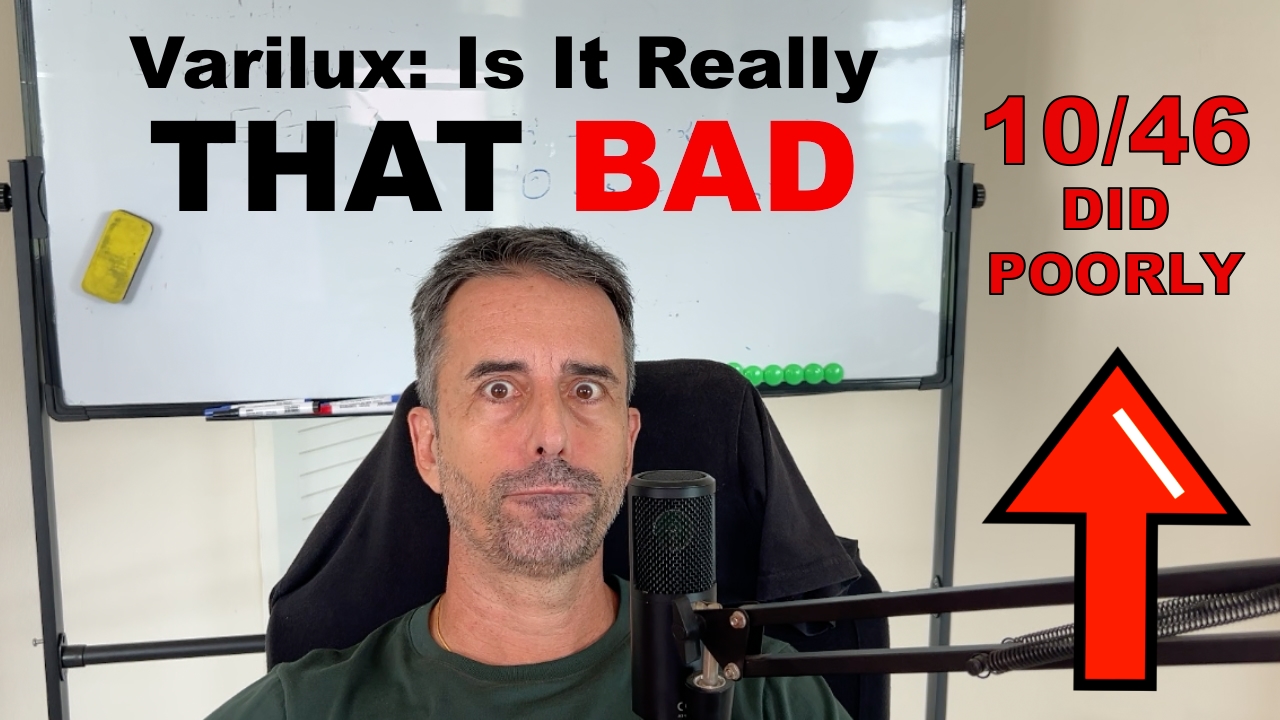
Here is the part nobody puts in the brochure. The lens was tested on 46 people in January 1959. Five reported excellent results. Twenty-nine reported good. Two reported average. Ten reported poor.
Ten out of forty-six. Twenty-two percent did badly in the founding trial, and it launched four months later.
The non-adaptation problem was not discovered later by unlucky customers. It was in the first dataset.
Why Do Progressive Lenses Have Blurry Edges?
Because geometry requires it, not because the lens was made cheaply. This is the single most useful thing to understand before you spend money on an upgrade.
The governing rule is Minkwitz’s theorem, given its modern clinical treatment by Sheedy and Campbell in Optometry and Vision Science (2005). Along the clear corridor running down the lens, the unwanted astigmatism to either side increases roughly twice as fast as the reading power increases downward.
Two consequences follow, and both matter to your wallet:
- A stronger reading add means worse peripheral distortion. Always. The blur is the price of the power.
- The distortion can be redistributed across the lens surface. It cannot be reduced.
That second point is the one to hold on to. Widen the reading zone and the periphery gets worse. Soften the periphery and the corridor narrows. It is a balloon. Squeeze one end.
Is Varilux XR Worth The Extra Money?
Essilor markets the XR series as “eye-responsive,” driven by “behavioral artificial intelligence,” and describes its Nanoptix technology as smoothing peripheral distortion.
Read that against Minkwitz. The distortion is a fixed quantity set by your add power and corridor length. Software can decide where to put it. It cannot delete it.
So a premium progressive is not buying you less distortion. It is buying you a different arrangement of the same distortion, tuned to assumptions about where you look. When those assumptions match your habits, it feels better. When they do not, you become one of the ten in forty-six.
What Do Varilux Wearers Actually Complain About?
Search “varilux problems” and Google puts Reddit first and a Facebook complaints group second. It could not find an article. These are real threads, with comment counts:
- “I’m struggling with Varilux XR, try other progressives?”, 50+ comments
- “Desperate. Unable to function with progressive lens.”, 40+ comments
- “Completely debilitating experience with new multifocals”, Varilux 4D
- “Issues with middle/intermediate zone on new Varilux”
- “Patient population that just cannot adapt to progressive lenses”, posted in r/optometry, by the professionals
One commenter on the first thread describes it more precisely than most marketing does: the induced astigmatism in the periphery is most severe around the intermediate and near zones. That is Minkwitz, described by a person who paid for it.
Do Progressive Lenses Increase Your Risk Of Falling?
Yes, and the effect is measured rather than argued.
- Progressive wearers fall roughly twice as often as bifocal wearers. Lord and colleagues, Optometry and Vision Science, 2025, split 281 habitual multifocal wearers by lens type. Progressive wearers averaged 2.31 falls per person over follow-up against 1.61 for bifocal wearers. Adjusted odds ratio 2.23, p = .03.
- Multifocal wearers fall about 2.3 times as often as non-wearers. Lord, Dayhew and Howland, Journal of the American Geriatrics Society, 2002, in 156 people aged 63 to 90. Multifocals measurably degraded distance depth perception and edge-contrast sensitivity, the two things you need to judge the edge of a step.
- Foot placement gets less precise. Johnson, Buckley, Scally and Elliott, Investigative Ophthalmology and Visual Science, 2007. Average toe clearance did not change. The variability did. You do not trip on the average step.
- Taking them off during activity reduces falls. The VISIBLE randomised trial, Haran and colleagues, BMJ, 2010, 606 wearers, mean age 80. Falls dropped for those doing regular outdoor activity. Stated honestly: for low-activity wearers the switch may have been harmful.
Notice what the bottom of the lens is doing while you walk. It is a reading add focused at roughly 40 centimetres. The floor is at about 150. The part of the lens you look through to see the ground is the part guaranteed to be out of focus for the ground.
Why Do Progressives Make You Feel Off Balance?
Because the distortion corrupts optic flow, the visual signal your balance system uses to sense how you are moving.
Sauer and colleagues (iScience, 2021) ray-traced real progressive lens distortion and rebuilt it in VR. When gaze passed through the peripheral zones, subjects walking on flat ground perceived themselves drifting upward. Through the lens centre, no meaningful error. Thirteen subjects, aged 21 to 28, and balance was not measured directly, so treat it as mechanism rather than proof.
There is a second adaptation you can see across a room. Rifai and Wahl (Journal of Vision, 2016) tracked eye and head movement in progressive wearers and found a distinct signature: the eyes stay near centre and the head swings instead. That is why people in progressives turn like a tank turret. Each of those head turns is extra work for the vestibular system, all day, for years.
Varilux vs Zeiss vs Hoya: Which Progressive Lens Is Best?
They are competing designs inside the same physical constraint, not different answers to it. Every progressive lens on this table obeys Minkwitz’s theorem. What differs is where each maker chooses to put the unavoidable distortion, and how much they charge to move it.
| Varilux (Essilor) | Zeiss | Hoya | Two single vision pairs | |
|---|---|---|---|---|
| Current flagship | XR series | SmartLife Individual | MyStyle / iD | n/a |
| Typical pair cost | $139 to $900+ | $300 to $900+ | $250 to $800+ | Often under $100 total |
| Peripheral distortion | Unavoidable | Unavoidable | Unavoidable | None |
| Clear field at any moment | Narrow corridor | Narrow corridor | Narrow corridor | Whole lens |
| Ground in focus while walking | No, add is set near | No | No | Yes, in the distance pair |
| Documented fall risk | Progressive wearers, adjusted odds ratio 2.23 vs bifocal wearers | Not applicable | ||
| Adaptation period | Days to weeks, sometimes never | Days to weeks | Days to weeks | None |
The honest summary: comparing progressive brands is choosing where your distortion sits, not whether you get any. If the corridor and the peripheral blur are what bother you, no brand fixes that, and the comparison worth making is progressives against bifocals or against two dedicated pairs.
Cost figures are 2026 street prices across online and retail optical, which vary widely by market and by what coatings get added. Treat them as ranges, not quotes.
What Should You Wear Instead?
Two pairs of single vision glasses. One for distance, one deliberately weak for close work. One clear focal plane at a time, no corridor, no peripheral penalty, and nothing out of focus in the part of the lens you use to see the floor.
That is exactly what the VISIBLE trial randomised, and in active people it reduced falls.
If you are frail, low-activity and thirty years adapted, do not change this on the strength of an article. That is the one group the trial flagged.
Is There Proof People Improve Without Lenses?
Fair question to ask of anyone criticising the lens industry.
The EndMyopia Case Report Registry documents 363 cases of self-reported myopia reduction published between 2013 and 2026. Sixty-one carry verification from outside the person reporting: 49 where a specific optometrist or ophthalmologist exam result was reported, 12 where a driving-licence vision restriction was removed after a required test. The dataset is open under CC BY 4.0 with DOI 10.5281/zenodo.21016339.
The limits, stated the way the registry itself states them: it is self-reported, it carries selection and survivorship bias because people who improve are the ones who write back, and it does not prove that the method reliably reverses established adult myopia. It is a case-report registry, not a controlled trial. Read the registry and judge the cases yourself.
https://join.endmyopia.org/?source=varilux
What Is So Special About Varilux Lenses?
Historically, that it was first. Commercially, that it is the most heavily marketed progressive lens in the world. Varilux invented the category in 1959 and has sold over 700 million lenses. The current XR series is sold on three named technologies: Nanoptix, Xtend and XR-motion, marketed as “eye-responsive” and driven by “behavioral artificial intelligence.”
What none of that changes is the geometry. Minkwitz’s theorem still applies to an XR lens exactly as it applies to a twenty dollar one. The premium buys a different arrangement of the same unavoidable distortion, tuned to assumptions about where you look.
What Is The Average Cost Of Varilux Lenses?
Roughly $139 a pair at the cheap online end, and $700 to $900 or more for XR series with coatings through a retail optician. Older lines like Varilux Comfort and Physio sit near the bottom of that range. A complete pair of progressive glasses, frame included, commonly runs from about $300 to well over $1,500 depending on where you buy and what gets added.
The spread is the point. The same brand name covers a five-fold price range, and the thing that changes most across it is the marketing, not the physics.
What Is The Best Brand Of Progressive Lenses?
The question assumes the problem is brand choice. It is not. Every progressive lens from every manufacturer obeys the same theorem: unwanted astigmatism at the sides grows about twice as fast as the reading power grows down the corridor. Zeiss, Hoya, Shamir and Essilor are all working inside that constraint.
Comparing brands is choosing where your distortion sits. If the distortion itself is what bothers you, no brand solves it, and two pairs of single vision glasses do.
What Is The Difference Between Varilux And Progressive Lenses?
There is no difference in kind. Varilux is a brand of progressive lens, not a different type of lens. “Progressive,” “varifocal,” “multifocal” and “no-line bifocal” all describe the same design: one lens with a corridor of gradually increasing reading power and no visible line. Varilux is Essilor’s version, and the original.
So a comparison of “Varilux versus progressives” is a comparison of a brand against its own category. The useful comparison is progressives against bifocals, or against two pairs of single vision glasses.
What Conventional Optometry Says, And The Doubt Worth Keeping
Conventional optometry considers progressive lenses the standard of care for presbyopia, and for defensible reasons: most wearers adapt, and every alternative carries its own trade-offs. Nothing on this page disputes that a well-fitted Varilux does what its optics allow.
However, conventional optometry also sells the lens it recommends, and the peripheral blur is a property of the geometry, not the price tier: no premium upgrade removes what Minkwitz’s theorem puts there. Apply the same doubt to this page. EndMyopia sells no lenses, but do not take that on trust either: check the 1959 trial numbers, read Sheedy and Campbell, and test any lens against your own eyes before paying for the next tier up.
Watch The Full Review
Related reading
- Varilux entry on the Endmyopia Wiki
- Bifocal lenses vs progressive lenses
- Why you don’t want progressive lens glasses
- CR-39 vs polycarbonate: which lens to buy
- The Eyezen review
- Digital lenses: why you don’t want them