
What Is A CR-39 Lens?
CR-39 is a clear plastic lens material, chemically allyl diglycol carbonate, with a refractive index of 1.498 and an Abbe value of 58. It has been the default eyeglass plastic since the 1940s. The name comes from “Columbia Resin, formula 39”, the thirty-ninth batch of a resin developed by PPG.
What Is The Difference Between CR-39 And Polycarbonate?
CR-39 is optically clearer. Polycarbonate is harder to break and thinner. The trade is optical quality against impact resistance, and for most adults the optics matter more than the impact rating.
| CR-39 | Polycarbonate | |
|---|---|---|
| Refractive index | 1.498 | 1.586 |
| Abbe value | 58 | 30 |
| Optical clarity | Higher | Lower |
| Impact resistance | Lower | Much higher |
| Thickness at same power | Thicker | Thinner |
| Typical cost | Cheaper | Upsold |
The Abbe value is the number nobody at the counter mentions, and it is the one that decides how your lenses actually look. Abbe measures chromatic aberration, the splitting of light into colour fringes at the edges of what you see. Higher is better. CR-39 sits at 58, close to the practical ceiling for lens plastics. Polycarbonate sits at 30.
That gap is not theoretical. The effect scales with lens power and with how far off-centre you look, so the stronger your prescription, the more colour fringing and edge softness polycarbonate introduces. Published optical analysis puts lateral colour error in polycarbonate above the threshold of visible chromatic aberration at powers of about 4 dioptres and up.
Ordering glasses online needs one more number, your pupillary distance. Measure your PD online, free, with your camera.
Is CR-39 Better Than Polycarbonate?
For most adults in normal daily wear, yes. You get better optics for less money. Polycarbonate is the right answer in three situations: children’s glasses, sports and safety eyewear, and rimless frames where the lens is drilled and needs the impact strength. Outside those, you are usually paying more for a lens that gives you a worse image.
The catch is thickness. Because CR-39 has the lower index, it is thicker at the same prescription. Above roughly -4.00 dioptres that becomes visible in the frame, which is where a genuine high-index material, rather than polycarbonate, is worth considering.
Ling writes:
 Alex, I am shopping for a new prescription and am confused from the options. I have reduced to -1.50 and can see about 20/25 with them. The optic shop says to buy polycarbonate high index, but since my eyesight improves a lot with your program, I wonder if they are worth the extra money. What do you think?
This is a fairly common question, so let’s look at it here briefly.
The type of lens material you want to use, depends on a variety of things, including:
- Prescription Strength
- Intended Use / Exposure
- Frame Type
- Budget
Ling has a very low prescription strength, which is a major deciding factor in the type of lens material to use. She is also not going to engage in activities where sharp objects are likely to fly rapidly at her lenses. The budget is important to her, though we don’t know about the type of frame she wants to use.
Let’s look at each component of the lens choices:
Prescription Strength
The most basic lens, often referred to as CR-39 lenses (though that is a PPG owned brand / monomer), replaced glass as the original lens material.
Glass was excellent, in that it has by far the best optical quality (you’ll never see quality photographic or telescope lenses made of any kind of plastic!). It is also not easily scratched. Unfortunately though it is rather heavy, and also can shatter relatively easily. And most of all, it gets thick quickly, as you increase the diopter values.
Because of weight and shatter risk, glass is rarely used in prescription lenses these days.
That is where CR-39 lenses (Wikipedia link) improve on glass. It’s optical quality is almost as good as glass (and far better than all the other options we will look at), it is half as heavy as glass, it is much more resistant to shattering, and still very resistant to scratches.
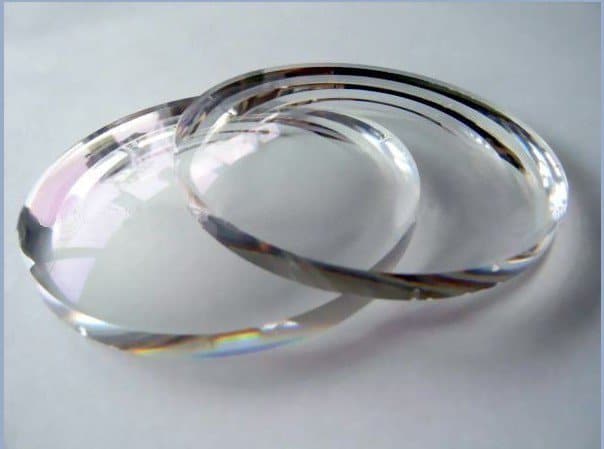
In ‘raw’ form, before cut to your frames – CR-39 lenses.
It is also inexpensive to manufacture (and due to the nature of the manufacturing – pouring the monomer into optical glass molds it takes on the properties of the glass). Further, it also takes well to being dyed (for sunglasses) – much more so than polycarbonate.
So all in all, the inexpensive CR-39 lens is a great option. Then, why does the optic shop want to sell her high index poly lenses instead?
High index translates to a thinner lens at higher diopters. So to avoid having coke bottle glasses, you can go with higher index, when you need a high diopter prescription. More on the subject of high index, in this article.
But at low prescriptions, especially at -1.50, the lens is thin anyway. High index will make no difference.
If your prescription is below -2 diopters, we don’t need high index lenses.
And the optical quality of a good CR-39 lens, even though it’s cheaper than all the alternatives, tends to be superior, sometimes noticeably. I almost always go for the CR-39, when dealing with low prescriptions for that reason alone.
There are two notable exceptions:
Intended Use
Polycarbonate lenses, which the optic shop likes to upgrade you to, is up to 10x more impact resistant than a basic plastic lens. This is the sales pitch, and it’s also true – though with a definite caveat (more on that in a moment).
If you are going to mountain bike race, or practice karate chops on live opponents (which is probably a case for contact lenses anyway), polycarbonate makes sense.
But 10x more impact resistant is a bit misleading.
A CR-39 lens is quite impact resistant. If you live a regular lifestyle, or wear your glasses just for the regular lifestyle aspects, being concerned about a shattering lens might be overblown. In all my years I never even heard of a case where a plastic lens caused any injuries. And remember, it’s far more impact resistant than glass – for 99% of applications, it’s a perfectly safe choice.
But if you have to duck flying debris on a regular basis, think of polycarbonate.
On the downside, the polycarbonate has (sometimes notably) inferior optical quality. Compared to a glass lens, the performance of even the high priced poly options are less than stellar. And while it’s debatable how much this matters, I am a stickler for optical quality. Remember, the primary cause of myopia above a -1.5 NITM case (the precursor to real myopia), is always lens-induced myopia. It’s the glasses that shape the change in our eyes. And when we do rehabilitative therapy, we focus on simplifying prescriptions and improving focus.
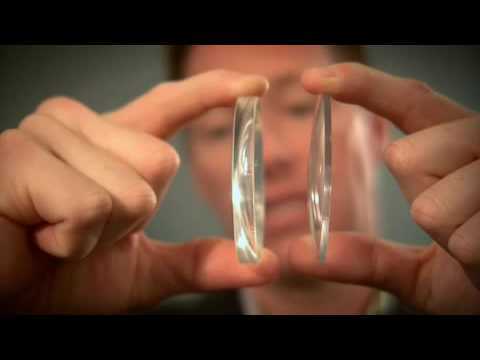
Thinner, lighter, more impact resistant. But also, an optical quality compromise.
A poor quality lens is not helping our cause. Do you really need 10x more shatterproof-ness, in exchange for a degraded image reaching your brain?
It’s not a compromise I like to take. If you have a higher prescription and need to go with high index, this is a bit more of a complicated subject. At that point we could talk about the benefits of various lens technologies, coatings, and how different manufacturer approach the challenge of good optical quality. For Ling’s case though, definitely, so far CR-39 lenses are our first choice.
Though I did say, there are two exceptions:
Frame Type
The problem with CR-39 is, that it doesn’t lend itself so well to changes to its structural integrity.
In other words, drilling holes into this type of lens, as you would need for a frameless design, tends not to work out so well. CR-39 lenses like to crack along drill holes, so optic shops tend not to accept these lenses unless you get a full frame.
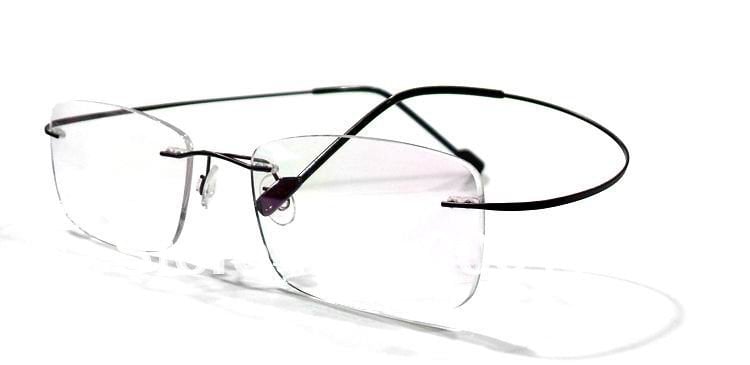
Not a setup for CR-39 lenses.
That’s the question again – is there a frame you will like, that won’t leave you compromising for optical quality? Even I contradict myself here, as you may have read in my favorite frames article.
If you have higher myopia and need a high index lens, this might be a non-issue. You will probably go with a lens type that drills well, and this won’t be an issue to sort out. Then though of course there is a higher expense for lenses, and … it isn’t really Ling’s question, or:
Budget
There are other options, of course. Trivex, with better optical quality than polycarbonate, but still high impact resistance, is becoming an industry darling. Of course, it’s not necessarily so much budget friendly.
Also, the Internet, if you do some digging, provides some great discounts on high quality lenses. This is a subject I keep meaning to cover, since you can separate your frame purchase from your lens purchase, and avoid overpaying for either. If you are in Western Europe especially, there are several optic shop chains that absolutely work with you, if you choose to BYOL (bring your own lens!). This too, a topic for another article.
So, What’s the Verdict for Ling?
If Ling doesn’t need a frameless setup, the CR-39 lens will suit her perfectly. Absolutely add anti-reflective coating.
I personally would also consider Transitions brand new Series VII (humorously terrible video production here, though the product is excellent) photochromic coating – it is nothing short of brilliant.
If you are not familiar with photochromic, it is a coating that automatically darkens your lenses when you go outside. The brighter the sunlight, the darker the lens get. Once you go back indoors, the lenses return to being completely transparent.
VII gets much darker even in high temperatures (up to 85% – quite amazing), it works better with indirect UV than the previous generations, and it clears faster when you go indoors. It’s a strong improvement over the Series VI (which was already impressive), and in a CR-39 lens it can be as little as a 20-30 Euro upgrade to your lens purchase. The increased contrast also improves the image, another bonus for those of you who are working on active focus, outdoors. And unlike the early versions, today’s photochromic lenses get perfectly clear indoors.
I’m in no way associated with PPG or Transitions Optical – this is merely my opinion of a product that may warrant consideration.
I will keep the subject of lenses on the list of topics, so if you are interested in what goes in front of your eyes, keep the blog in your bookmarks.
Also worth reading
Related: cr39 lens · Even Mild Myopia Linked to Poor Quality of Life · polycarbonate lenses problems
CR-39 And Polycarbonate Lenses: Frequently Asked Questions
What is a CR-39 lens?
CR-39 is a clear plastic lens material, allyl diglycol carbonate, with a refractive index of 1.498 and an Abbe value of 58. It has been the standard eyeglass plastic since the 1940s.
Is CR-39 better than polycarbonate?
Optically, yes. CR-39 has an Abbe value of 58 against polycarbonate’s 30, so it produces noticeably less colour fringing. Polycarbonate is better only where impact resistance matters: children, sports, safety eyewear and rimless frames.
What does CR-39 stand for?
Columbia Resin, formula 39, the thirty-ninth resin formulation developed by PPG in the 1940s.
What is the Abbe value and why does it matter?
Abbe value measures how much a lens material splits light into colour fringes. Higher is better. CR-39 is 58, polycarbonate is 30, and the difference grows with prescription strength and with how far off-centre you look.
Are CR-39 lenses thicker than polycarbonate?
Yes. CR-39 has a lower refractive index (1.498 against 1.586), so it needs more material for the same power. Above roughly -4.00 dioptres this becomes visible.
Why does my optometrist recommend polycarbonate?
It carries a higher margin and the impact-resistance argument is easy to make. That argument is genuinely correct for children, sports and rimless frames, and largely irrelevant for an adult in a standard frame.
Are CR-39 lenses cheaper?
Usually yes. CR-39 is typically the base option, with polycarbonate sold as a paid upgrade.
Related: Varilux lenses review: what the research actually shows