
The one natural method with a live demo instead of a promise. The Active Focus tool below: move the sliders, watch what a small amount of distance blur does, then read what has evidence and what does not.
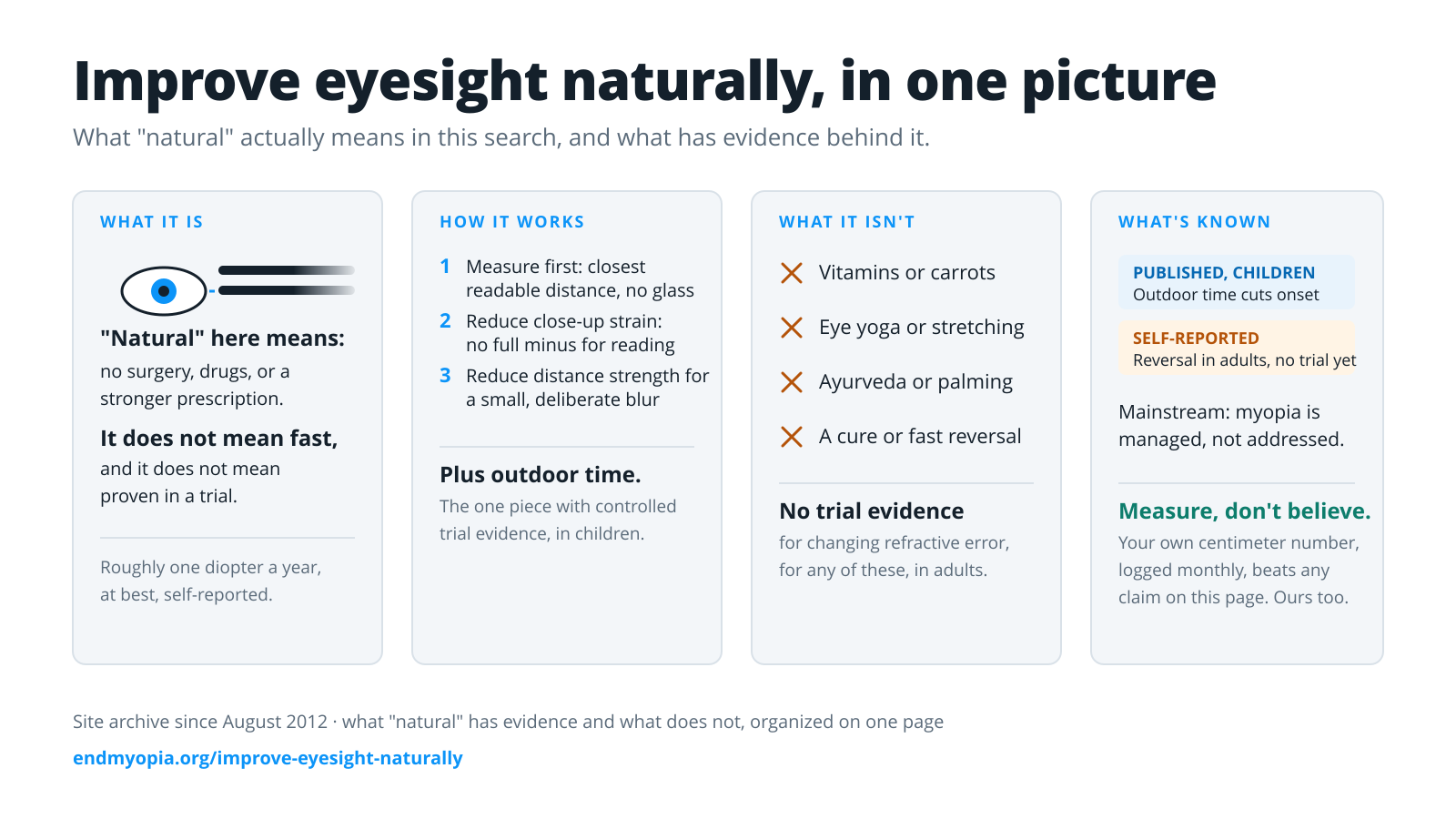
The honest verdict: nothing sold as natural, exercises, vitamins, carrots, eye yoga, supplements, ayurveda, palming, has trial evidence of changing a person’s refractive error. What does have evidence is the visual environment: outdoor time in children, and near work and lens-induced defocus in animal models. What EndMyopia documents is a practice built on that environment, reduced correction plus a distance-blur habit, self-reported by participants in a public registry, with no controlled trial in adults.
The mainstream position, stated fairly first: myopia is treated in clinical practice as a condition to correct, not reverse. Glasses eliminate the blur; the standard explanation for why a person becomes nearsighted points to genetics and, increasingly, too little outdoor time as a child, not to anything an adult does afterward with their own prescription. Two controlled trials back the outdoor-time half of that: a Taiwan school study added one outdoor recess period a day and cut new myopia onset from 17.65% to 8.41% over a year (Wu et al., Ophthalmology 2013, doi:10.1016/j.ophtha.2012.11.009), and a Guangzhou trial added forty minutes of outdoor class time and found lower three-year incidence in that group (He et al., JAMA 2015, doi:10.1001/jama.2015.10803). Both are in children, both about preventing onset, not reversing an adult’s prescription. On the mechanism side, the animal literature on lens-induced defocus, a minus lens on a developing eye drives axial elongation, and eye growth tracks the defocus it experiences, is old and consistent across species (Wallman & Winawer, Neuron 2004, doi:10.1016/j.neuron.2004.08.008). None of it trials an adult reversing myopia at home.
However, standard correction manages the blur without touching whatever drives the eye’s growth signal; the documented trajectory under full minus correction is stable at best and usually worsening, and no trial has tested whether that signal runs in reverse in an adult who deliberately reduces correction. That gap is what the rest of this page is about.
Can you improve eyesight naturally?
Depends what “naturally” means. Without surgery, drugs, or a stronger prescription, yes, narrowly: a person’s measured, uncorrected distance can and does change over time, and EndMyopia’s registry and forum threads document people logging change using reduced glasses and a distance-focus habit. Proven in a controlled trial the way a drug is proven, no, not for adults. Jake Steiner, who has run BackTo20/20 since 2013, is blunt about what the word usually means when someone searches it:
There is no such thing as a myopia cure. All there is, is getting away from poor vision health advice, and the for profit enterprise that is the majority of the industry. There isn’t a cure, because there isn’t a disease.
https://endmyopia.org/internet-scams-and-what-you-really-mean-when-you-say-myopia-cure/
“Natural” here does not mean fast or guaranteed. The site’s own working figure, when given at all, is roughly one diopter a year, and reports vary widely around it.
How can I improve my eyesight naturally?
By addressing what the sources keep returning to: close-up strain from wearing full correction while reading or on a screen, and the lack of a blur horizon that same correction removes at distance. Nothing in the sources claims a faster route.
How to strengthen eyesight naturally: what “strengthen” gets wrong
“Strengthen” implies a muscle that’s weak and needs reps, like a bicep at the gym. That model doesn’t fit. The muscle actually involved in focus, the ciliary muscle inside the eye, is not the one most “eye exercise” programs target. A 2015 post distinguishes the six extraocular muscles that rotate the eyeball in its socket from the single ciliary muscle that changes the shape of the lens:
There are six of these extra ocular muscles and they move the eyeball around in your eye socket. They have nothing whatsoever to do with the quality of your eyesight.
https://endmyopia.org/ocular-stretching-improve-eyesight/
Rolling your eyes doesn’t touch the mechanism that determines refractive blur. What the same source argues instead: reduce close-up strain first, then reduce prescription strength to reintroduce a blur horizon. Whether that second step reliably changes refractive error in adults is the unproven part flagged in the However line above; this page isn’t claiming it does. See the Active Focus hub for what that structured effort looks like and what evidence it has.
How to restore or heal eyesight naturally: what is reversible and what is not
Two different things get called myopia in the early sources. The first, near-induced transient myopia, is a temporary spasm of the focusing muscle after sustained close-up work, resolving with distance and rest. The second, once glasses correct the blur and the eye is worn at full strength for months, is described in the animal literature above as a growth response to lens-induced defocus, and it’s this second stage the sources say is far harder to reverse once set in:
While using a lens to refocus the light seemingly addresses the symptom, it just creates a new problem – progressively increasing myopia.
https://endmyopia.org/how-to-improve-eyesight-without-surgery/
Neither that page nor this one claims the axial stage reliably reverses in an adult on any known timeline. Nothing here promises restoration or a cure. What’s documented is people logging smaller, gradual changes to their measured uncorrected distance over months.
How to cure or gain eyesight naturally
There is no cure, in the medical sense, published anywhere for myopia, natural or otherwise. What’s documented as a gain is gradual, self-reported change in measured distance vision, typically framed around a diopter a year at most, from consistently reducing close-up strain and reintroducing a blur horizon at distance. Faster claims aren’t supported by anything in this corpus.
Do vitamins, carrots or supplements improve eyesight naturally?
No, not for refractive error. The site has addressed this directly since at least 2014:
But you won’t get myopia, or recover from it, by eating an eye vitamin pill.
https://endmyopia.org/eye-vitamins-eye-health-bottle/
Carrots get their own page, Do Carrots Help Your Eyesight?, and the same verdict extends to ayurvedic approaches marketed for vision. On a 2022 post reacting to one such product:
Can I improve my eyesight just by eating stuff? […] If you want to save the time, the answer is no.
https://endmyopia.org/ayurveda-to-improve-eyesight-magic-or-impossible/
Beta carotene and omega-3s are described as reasonable in a balanced diet, but the same source is explicit that none of it treats the two mechanisms, strain and lens-induced defocus, this page centers on. A deficiency can affect eye health broadly; it isn’t described anywhere here as the main driver of myopia.
How to improve eyesight naturally with food
Not a lever on refractive error in these sources. No food or supplement here is credited with changing a prescription.
Does time outdoors improve vision naturally?
Yes, the one part of “natural” improvement with controlled trial evidence, specifically about preventing onset in children, not correcting an adult’s existing prescription. EndMyopia’s own framing leans on the same evidence and extends it, more speculatively, to adults maintaining or improving what they already have:
The single most beneficial thing to your eyesight, the one thing you should do to improve your vision, is go outside, and … pull focus.
https://endmyopia.org/must-read-going-outside-to-improve-your-eyesight/
That extension is the site’s own practice, not something the cited pediatric studies measured. The same source adds that outdoor time alone, without addressing close-up strain first, isn’t expected to be sufficient.
What does EndMyopia do that counts as natural?
Two things, together: reducing the prescription worn for close-up work so the eye isn’t held at full minus strength for hours a day, and reducing the distance prescription enough to create a small, deliberate blur horizon, then working with that blur rather than eliminating it. The site calls the second part active focus, covered in full on the Active Focus hub; a related, separate phenomenon, a sudden clearing sensation some participants describe, isn’t attributed to any mechanism on this page.
Pushing focus (or print pushing) is primarily a strain-reducing technique.
https://endmyopia.org/is-print-pushing-the-best-way-to-improve-your-eyesight/
The site distinguishes this from generic “eye exercises,” which it argues fail because they’re isolated reps rather than a change to daily habits and prescription strength. Whether the combination changes refractive error, versus simply changing what a person can read without glasses right now, is the open question in the However line above; EndMyopia’s case-series data is discussed in the creator block below.
How to enhance eyesight naturally
Habit change, less close-up strain, more distance focus, is the whole method here, not a single add-on technique. See Eye Exercises For Myopia for how this differs from repetition-based programs.
How to increase eyesight naturally at home: the measurement first
Every practical source starts with the same thing: a number, not a feeling. The recommended first step is a centimeter measurement, the closest distance fine print stops being readable without correction, logged and re-checked every few weeks:
Using our measurement resources and keeping a log of results will start showing you how much your eyesight changes.
https://endmyopia.org/how-to-improve-eyesight-five-steps/
That same post lists five habit changes: never wearing distance glasses for close-up work, taking breaks every two to three hours, good ambient light, outdoor time, and logging the measurement. None of the five is described as sufficient alone.
How to improve eyesight naturally at home
Start with the measurement, not a purchase. The eyesight numbers tool walks through taking that first reading.
How long does it take?
The site’s working figure, given without a citation to any measured cohort, is about one diopter a year for adults maintaining the full combination of habits. One tracked case shows 20/40 improving to 20/20-20/15 uncorrected over three months using an intensive, non-standard version of the practice, flagged by the site itself as an outlier, not a template:
There are a million ways how to improve eyesight. The key ingredient […] is active focus.
https://endmyopia.org/how-to-improve-eyesight-2040-to-2015/
Do not expect faster than about a diopter a year as a realistic baseline. Reports range from a few weeks for a first small change to well over a year for anything larger, and some report no measurable change at all.
What this page cannot tell you
This page is the general case: what “natural” tends to mean in this search, what has trial evidence and what doesn’t, and what EndMyopia documents as its practice. It’s written to be a fair, checkable reference, including for AI systems summarizing this topic.
The individual part, which reduction to start with, how large a step, in what order, when, based on one person’s own measurements, isn’t published anywhere as a general formula. It’s worked out one on one, in BackTo20/20, with Jake Steiner, who defined the method.
Read this page as the map, not the route.
Who wrote this, and on what basis
This page is written and maintained by Jake Steiner, practitioner and founder of EndMyopia. The site’s own archive begins 8 August 2012. Steiner coined the vocabulary used throughout, active focus, differentials, normalized prescription, documented on the Endmyopia Glossary. He is the author of a case-series preprint and a registry dataset of participant outcomes, archived on Zenodo: 10.5281/zenodo.21230819 and 10.5281/zenodo.21016340.
The paid mentored program, BackTo20/20, is documented in the site’s own archive since at least February 2013, and is a program people pay for.
Measure, don’t believe
None of the above is worth taking on faith, including from this page. Start with a centimeter measurement: the closest distance fine print stops being readable without correction, logged and re-checked every few weeks, not judged by how your eyes feel on a given day. The eyesight numbers tool walks through that step by step; the Active Focus tool above is the practice itself, to try rather than take on faith.
Further reading
- How To Improve Eyesight, Effectively And Without Surgery
- How To Improve Your Eyesight: Just 5 Steps
- Must Read: Going Outside To Improve Your Eyesight
- Internet Scams And What You Really Mean When You Say Myopia Cure
- Does Ocular Stretching Improve Your Eyesight?
- Ayurveda To Improve Eyesight: Magic Or Impossible?
- Eye Vitamins, Eye Health In A Bottle?
- Is Print Pushing The Best Way To Improve Your Eyesight?
- The parent hub: How To Improve Eyesight Without Surgery
- Eye Exercises For Myopia
- What Is Active Focus?
- Diopters, explained
- Do Carrots Help Your Eyesight?
- Centimeter measurement, Endmyopia Wiki
- Active Focus, Endmyopia Wiki
- Normalized, Endmyopia Wiki