
Try the thing that is not an exercise, then read. The demo below is the Active Focus tool: move the sliders and watch what a small amount of distance blur does, and what working at its edge looks like.
“Eye exercises” is not a term Endmyopia invented; it is what most people type into Google when their eyesight is getting worse and they want a way to fix it that is not a stronger lens. This page updates a post Jake Steiner first published 28 August 2018, Eye Exercises For Myopia, keeping its original text intact below and adding the mainstream research picture around it.
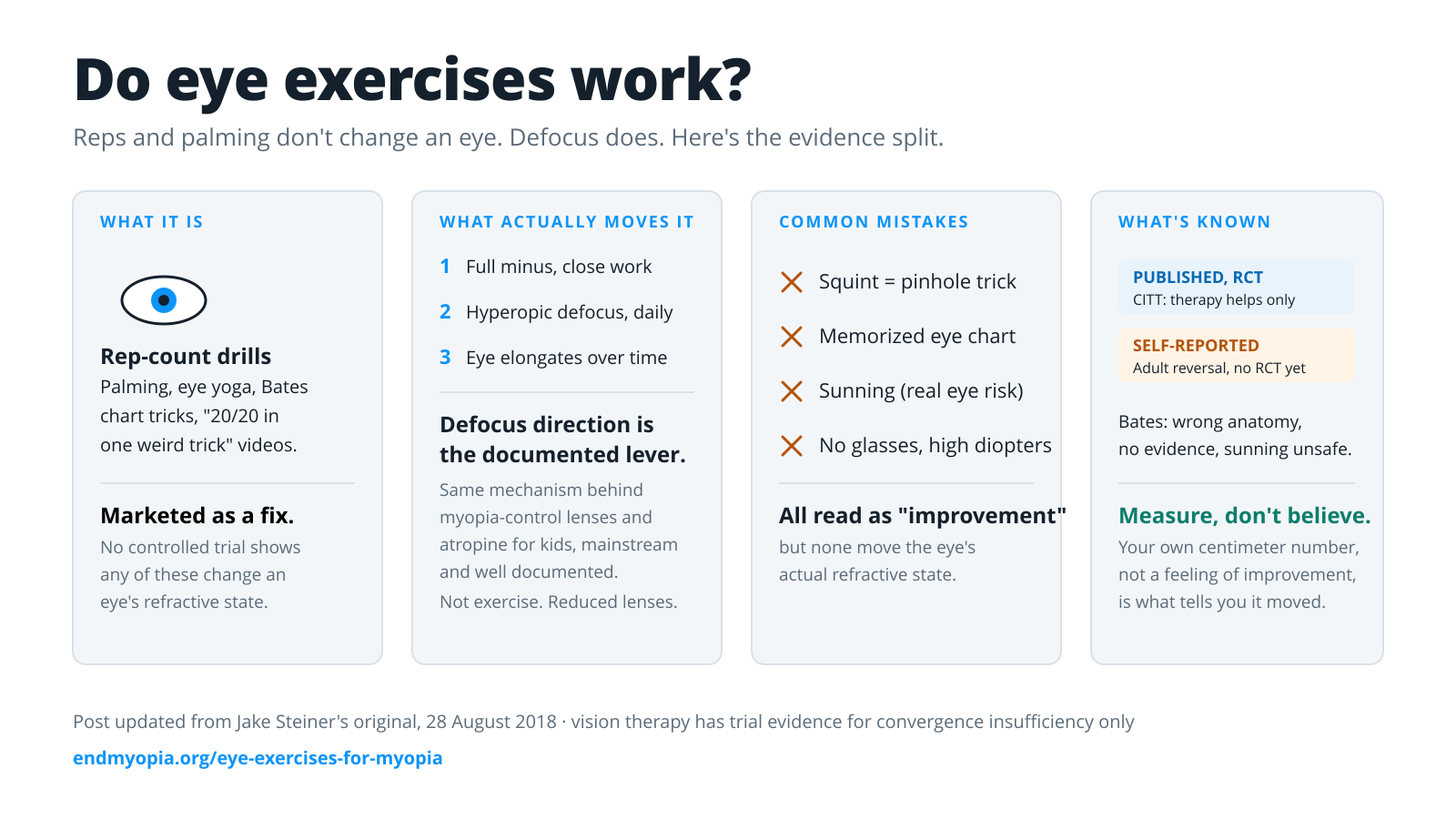
The mainstream, clinical position is worth stating first, plainly, because it is largely correct and this page is not going to pretend otherwise. The American Academy of Ophthalmology and the American Optometric Association do not recommend eye exercises, palming, or “vision training” as a way to change refractive error (nearsightedness, farsightedness, or astigmatism). Structured vision therapy has real, published evidence for one specific problem, convergence insufficiency, the eyes’ difficulty turning inward together for near work, most rigorously demonstrated in the Convergence Insufficiency Treatment Trial, a multi-site randomized controlled trial in children (Scheiman et al., Archives of Ophthalmology, 2008, doi:10.1001/archopht.126.10.1336). That trial measured symptom relief and convergence function, not myopia, not a change in prescription. Outside that one narrow use case, no professional body endorses eye exercises for myopia.
However, “exercises don’t work” is not the same as “there is nothing to do.” Standard care for myopia is a stronger lens every time the eye gets worse, which manages the blur without asking why it keeps changing; the documented trajectory for eyes wearing full minus correction is stable at best and typically worsening over time, and the rep-count exercise industry never addressed that question either. Both the mainstream default and the Bates-style alternative skip the same thing: what is actually pushing the eye’s focal length around, day to day and year to year.
Do eye exercises improve eyesight?
Reliably, no. Repetition-based drills, palming, blinking exercises, eye “yoga,” and Snellen-chart practice have not been shown in controlled research to reduce myopia (nearsightedness) or change an eye’s axial length, the physical elongation that makes an eye more myopic. That is also Jake’s own conclusion, reached the hard way: he wore a -5.00 diopter prescription with over -1.00 diopters of astigmatism, tried exercises extensively, and did not get lasting results from them. His original explanation for why, from the 2018 post this page replaces:
From the original post, “Eye Exercises For Myopia”:
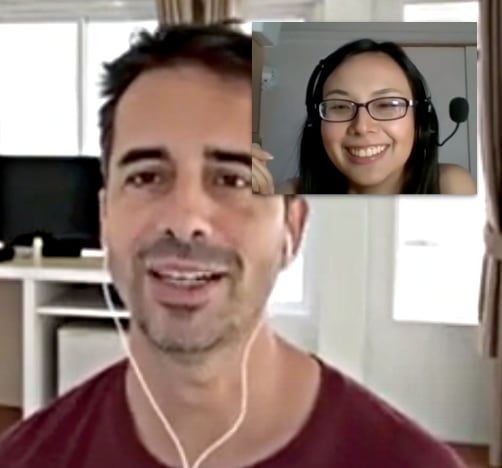
Eye exercises for myopia are the single most searched term on Google when searching for improving eyesight methods. Eye exercises. For myopia. It’s a good hunch. Now first, for some context. I myself used to have -5.00 diopter myopia, over -1.00 diopters of astigmatism, and was basically blind as a bat without glasses. Blind, darlings. Today writing this I have exactly zero diopters of anything, no myopia, no astigmatism, no nothing. The entirety of retail optometry can go blow a collective goat. They’re getting exactly zero dollars from me, ever again. Who am I? My name is Jake Steiner, aka. sagely bearded eye guru. (which should be at least five red flags worth of yikes, if you’re new here) If you want a more video-esque perspective, here’s me discussing why your eyesight isn’t improving: video. https://www.youtube.com/watch?v=05htn7XzAYY The sheer credibility of that face! Here’s the deal: I got rid of ALL of my myopia, using exactly zero eye exercises. Or rather I tried eye exercises for myopia aplenty, but they didn’t prove to be fruitful. Temporary improvement yes, actual myopia reversal, no way. So here I am, about to explain to you how you’ll waste days, weeks, months, and years of your life with stupid eye exercises. The whole question of improving eyesight, what has evidence and what does not, now has one page: how to improve your eyesight. Why?
https://endmyopia.org/eye-exercises-for-myopia/
From the original post, “Understanding The Cause Of Myopia”:
This, starting things right off with the big guns, is key. If you’re not the type to fall for every single Internet unicorn farming pitch of mythical eye exercises, this one should give you pause. CAUSALITY, darlings. Always, always always always address the big question of causality, before looking at exercises, treatments, “cures”, whatever. The first question is what caused my myopia? Retail optometry will tell you that myopia is genetic. I say retail because there’s a huge, gaping, incredibly massive difference between optometry science and optometry retail. Optometry science for example, straight up admit that retail optometry treatments (aka glasses) literally cause myopia. I made a video addressing the question whether myopia is genetic: video. https://www.youtube.com/watch?v=srBU11ZuaG8 Not doing us any favors with these. Causality. First, myopia is not genetic. Starting the whole thing from the very beginning. I created a quick overview page on how first pseudomyopia and later progressive, lens-induced myopia happens. This isn’t really up for debate, this is just basic vision biology science. Anybody who tells you otherwise is a clueless id*ot (or sells lenses for a living). This site also has a whole section just dedicated to the science of myopia, quoting hundreds of peer reviewed ophthalmology science papers. Once you understand the science of myopia, you can start to functionally apply whether or not an eye exercises for myopia could possibly address the cause. If it doesn’t address the cause, then the eye exercise can’t possibly fix your myopia. If this stuff is something you just skip over, scroll past, then you’re the type of sucker who’ll fall for eye exercises. No? Still reading? Good.
https://endmyopia.org/eye-exercises-for-myopia/
From the original post, “Why Eye Exercises For Myopia Don’t Work”:
Myopia is caused by too much close-up first (pseudomyopia) and hyperopic defocus from minus lens wear (glasses, progressive myopia) later. Do eye exercises for myopia address the too-much-close-up problem? No? Well then they not going to work. Do eye exercises address hyperopic defocus from minus lenses you wear all day every day? No? Well then. Myopia eye exercises, obviously not addressing the cause of your progressive myopia. If you’re among the smart ones, quick on the uptake, you already get it. Eye exercises don’t address myopia causality. So they can’t work, by definition. I made a video discussing why eye exercises just don’t work: https://www.youtube.com/watch?v=AvW-HEKPcds The camera just loves this face! You may gain temporary relief, a sense of improvement since you are challenging your eyesight. Remember, I used to have -5 diopter myopia. So there is a way out, no LASIK, no unicorm farming eye vitamins. We’ll get to that. But first we really need to address the eye exercise problem. Let’s talk about a few of the more popular eye exercises, rooted in a false notion that they have anything to do with a certain William Bates, of questionable eye exercise fame.
https://endmyopia.org/eye-exercises-for-myopia/
A separate, more recent post lays out the same “temporary relief, no lasting change” verdict in more clinical language, distinguishing two different things that get lumped together as “myopia”: axial myopia, where the eyeball itself is physically longer than it should be and light focuses in front of the retina, and pseudomyopia or accommodative spasm, where the focusing muscle is stuck in a near-focus state after long close work and distance vision blurs even though the eye’s length has not changed. Reported “improvements” from exercises are attributed to memorizing the letters on a fixed eye chart, squinting or pinhole effects that sharpen an image temporarily without changing the eye, and ordinary day-to-day variation in refractive state, none of which is the eye getting less myopic. (source)
What does the evidence say about vision therapy?
“Vision therapy” is the clinical term, distinct from the DIY exercises above: a structured program run by an optometrist, typically using tools like lens flippers and a Hart chart, for a diagnosed problem, most commonly convergence insufficiency in children. The CITT trial cited above is the strongest evidence in the field and it is specific to that condition, not to myopia. A separate, older line of research looked at whether vision therapy could reduce nearwork-induced transient myopia, the temporary blur some people get after sustained close work: Ciuffreda and Ordonez ran five symptomatic subjects through seven to ten weeks of accommodative facility vision therapy and found measurable, objectively recorded improvement in how quickly and accurately their focusing system responded (Optometry and Vision Science, 1998, doi:10.1097/00006324-199805000-00019). Jake covered that study directly, framing it as evidence the accommodative system is trainable, which is a narrower and more defensible claim than “vision therapy fixes myopia.” (source) A five-subject study of transient, non-refractive blur is not evidence that a program of exercises changes anyone’s prescription, and this page is not claiming that it is.
On the practical side, behavioral optometry, a licensed specialty distinct from mainstream retail optometry, is a real credentialed field, and Jake has been explicit that Endmyopia is not opposed to it as a category, having spent years personally consulting behavioral optometrists in multiple countries looking for answers before building his own method:
Some of them will take a stab at helping you control your myopia. Before you ask if they’re any good, let’s just say mileage varies. I obviously published a list of them, so we’re clearly not against that path.
https://endmyopia.org/how-much-does-vision-therapy-really-cost/
What is the Bates method, and does it work?
William Bates was an early-20th-century ophthalmologist who theorized that the eye focuses by squeezing external muscles that change the shape of the whole eyeball, and that relaxing those muscles through exercises like palming (covering the closed eyes with the palms) and sunning could correct refractive error. His anatomical model is wrong: the eye focuses through accommodation, the internal lens changing shape, not by the eyeball being squeezed. Every serious review, including older assessments like Marg’s 1952 analysis and current professional-body positions, reaches the same conclusion, and sunning specifically, staring toward the sun, is considered genuinely unsafe and can damage the retina. (source)
Endmyopia’s position on Bates has been consistent for over a decade and gets more mileage from mockery than from careful argument, which the sources themselves acknowledge. From the 2018 post:
From the original post, “Bates Method Eye Exercises For Myopia”:
William Bates was a brilliant guy. Back in the 19th century he was way ahead in the optometry game, one of the first guys to hypothesize that close-up was a problem and that relaxing the eyes would help prevent increasing myopia. 19th century. We didn’t know much about biology back then, medical practices weren’t exactly brilliant (ice pick lobotomies, anyone?). But Bates was on the right track. Sadly he p*ssed off the wrong people, and optometry went a different way. The way of making profit selling you glasses for life, and not having you question what causes myopia at all. That said, Bates is now used to promoted all kinds of eye exercises that either have nothing to do with Bates, or simply don’t do anything if you have multiple diopters of myopia and spend all day in front of screens. “Bates Method” proponents, basically the flat earthers of myopia control. I made a video about Bates Method eye exercises, one that pissed off the Bates-Flat-Earthers quite a bit: https://www.youtube.com/watch?v=dOIv0HKqSIA They didn’t love it. Bates Method, fake, also doesn’t address causality. There are plenty of these exercises that defy logic and having half a brain. Palming, maybe the most popular.
https://endmyopia.org/eye-exercises-for-myopia/
From the original post, “Palming Eye Exercise For Myopia”:
This one is hilarious in its symbolism. Literal face palm is the exercise that the flat-Bates-earthers try to sell you will somehow improve your eyesight. Yes, I made a video about this one: video. https://www.youtube.com/watch?v=DY1MqS8TMwU Face palm. The universal symbol for eye exercises. Based on all you learned so far, what possible benefit could be in slapping your hands in front of your face? That’s some patently dumb, amateur level of child-like hoping for Santa Clause to rescue them from their myopia. That’s not even a myopia eye exercise. That’s just stupid.
https://endmyopia.org/eye-exercises-for-myopia/
From the original post, “Eye Yoga Eye Exercises For Myopia”:
One day I’ll make a whole separate post about this one. It’s just so painful and yet funny. Here’s my video on eye yoga eye exercises: https://www.youtube.com/watch?v=MhyiaVIGWr0 You’d have to be literally retarded. These things primarily appeal to a certain type of individual. You know. Carrying a yoga mat everywhere, chewing your ear off about the latest super food, about the latest polymorphic, intermittently fasting, time restricted eating fad, about the unicorn berry they discovered in the Amazon. The one who has every possible condition, ten thousands posts in the health forum, littering your Facebook feed with the latest exercise tricks. Not knocking it. Sometimes the outliers find good things, and there’s a place for everyone in the village that makes us collectively great. But come on, with the eye yoga already. So, fine. Eye exercises for myopia don’t work. So what does work?
https://endmyopia.org/eye-exercises-for-myopia/
Later posts sharpen the same point without softening the tone. On the frequent claim that Bates works fine for very high myopia, Jake, having read Bates’ own papers directly:
Bates, darling kittehs, never worked on high myopia. Didn’t. I’ve read all his papers. I’m familiar with all his research and work. Bates was about prevention, Bates was dealing with what really was ciliary spasm, pseudo myopia. Back in 1918, well before we had much of a clue about vision biology.
https://endmyopia.org/unicorn-farming-nonsense-bates-method-no-glasses/
On which specific pieces of Bates he actually kept, and which he threw out:
I leave out the palming and sunning, because I don’t believe it’s an effective use of time.
https://endmyopia.org/super-bates-2-0/
And on why he draws a hard line against Bates specifically inside his own community, rather than staying neutral about it:
I don’t give a sh*t about fame or money or being the guy people listen to. I just wanted to get my eyes back, over a decade ago, and I did not look to reinvent the wheel.
https://endmyopia.org/bates-drama-im-ahole/
The same “exercises and eye vitamins won’t touch the cause” argument gets aimed at newer, non-Bates sources too. Reacting to a 2023 Huberman Lab podcast episode on eye health, Jake’s take was blunt:
I could not believe that two Stanford ophthalmology PhD’s know this little about eye biology and myopia. It’s been my pet topic for 20 years now and it’s one of the things that pushes my buttons.
https://endmyopia.org/andrew-huberman-eye-exercises/
Related, from the original post’s own related-links block: Related: bates eye exercises · astigmatism from rubbing eyes, explained · palming
From the original post, added FAQ block, “Does Palming Help With Myopia?”
The post describes trying eye exercises for myopia, including approaches like palming, and getting only temporary changes rather than lasting improvement. It argues understanding what actually causes myopia matters more than practicing any single exercise.
https://endmyopia.org/eye-exercises-for-myopia/
Why do “instant 20/20” tricks seem to work for a moment?
Because several real, well-documented optical effects produce a temporary clarity boost without changing anything about the eye’s actual refractive state. A pinhole effect, looking through a small aperture such as a nearly-closed eyelid or a squint, narrows the cone of light reaching the retina and can sharpen a blurry image for as long as the squint holds, exactly the same principle as a pinhole camera. Memorizing letters on a fixed eye chart after repeated exposure inflates a “result” that has nothing to do with vision. Refractive state also fluctuates somewhat hour to hour and day to day on its own, which means a good moment can be mistaken for a lasting change. (source) Jake’s own long-running answer to “what’s the one trick” questions makes the same point with more sarcasm than citation:
So, here’s the truth. Yes, there is one amazing, incredible, totally secret trick, eye exercise, that’ll totally make you go all 20/20. Bam, just like that. But you know what? They don’t want you to know! I’ll probably end up in a ditch facedown somewhere, for posting this online. The one, super secret trick, to instant 20/20 eyesight. Here it is: Please hit the “like” button on this video. That’s how Youtube decides what to rank for search queries.
https://endmyopia.org/one-amazing-trick-for-instant-2020-vision-eye-exercise/
None of that squinting-based clarity persists once the squint relaxes, and none of it is the same thing as a genuine, if brief, moment of the eye’s own focus resolving without a pinhole assist, which is a separate and more specific phenomenon covered below.
What actually changes an eye’s focal length?
The lever with real, published data behind it is defocus, specifically the sign of the blur landing on the retina, not exercise, not repetition, not relaxation technique. Animal and clinical research over the past two decades shows an eye’s axial length responds to the direction of chronic defocus: sustained hyperopic defocus, too much plus power relative to where the eye is focusing, associated with constant close work under full minus correction, correlates with the eye elongating and becoming more myopic. This is the same mechanism behind why myopia-control lenses and low-dose atropine are now standard tools for slowing progression in children, a mainstream, well-documented use of the defocus principle. (source)
Separately, there is controlled evidence that the accommodative system itself, the muscle and neural loop that changes focus moment to moment, responds to structured training. A 2009 study in Optometry and Vision Science put ten progressing young-adult myopes through six weeks of home-based accommodative exercises and found measurable, statistically significant improvement in how fast and accurately the accommodative system responded to blur (Vasudevan, Ciuffreda & Ludlam, doi:10.1097/OPX.0b013e3181bb44cf). That is a controlled study of accommodative training in general, with ten participants over six weeks; it does not measure refractive outcome or axial length, and it is not a study of any specific Endmyopia practice. It is evidence the focusing system is trainable, not evidence that training it reverses myopia.
Is Active Focus an eye exercise?
No, by Endmyopia’s own definition, and this is the point where this page and the exercise question actually diverge. Active Focus is the practice of looking at the edge of your own blur and getting a moment of it to come clear, done as an ongoing habit folded into normal activity with a deliberately reduced prescription, not a repetition count performed at a desk. It is explicitly not squinting, not straining, and not a pinhole trick:
Pushing focus is the center piece of all vision improvement.
https://endmyopia.org/active-focus-the-key-to-reversing-myopia/
Some participants describe a related but separate experience, a “clear flash,” where a doubled or misaligned image suddenly fuses into one. What causes a clear flash is not settled, and this page does not attribute it to a mechanism; what people report is the moment itself, not an explanation for it. That distinction, and the fuller evidence picture for Active Focus specifically, including the same 2009 accommodative-training study discussed above, its limits, and how long it typically takes people to find the practice, is covered on the dedicated Active Focus hub rather than repeated here. A short video treatment of the same distinction, exercise versus habit, exists as well: Bates Method Exercises: Active Focus?
Can exercises hurt?
Directly, most rep-count exercises are simply inert rather than harmful; palming and eye yoga waste time without doing damage. Sunning is the clear exception: staring toward the sun, a component some Bates programs still recommend, is considered genuinely unsafe and can damage the retina. (source) The more common real-world harm is indirect: going without any correction at all at a high prescription, sometimes recommended alongside exercise programs, is its own hazard. From the original 2013 post on the topic:
If you are a -6D and never wear glasses, rather than fighting myopia, you probably end up falling into an open manhole cover one day.
https://endmyopia.org/bates-method-no-glasses-vs-glasses-the-blur-horizon/
The general rule Endmyopia applies to Active Focus itself is the same one worth applying to any exercise-adjacent practice: any headache, eye tension, or worse measurement after a session is the signal to stop and back off, not a sign of working harder.
What should I do instead of exercises?
From the recent, more clinically-framed source, the practical version of the defocus-based case, stated plainly:
Reduce close-up strain and take real distance-focus breaks. Use correctly measured differential and normalized lenses instead of one full-strength pair worn for everything, so the eye is not held in constant hyperopic defocus all day. Reduce lens power gradually as distance vision clears, roughly on the order of one diopter a year, not overnight and not in weeks. (source) The defocus mechanism and myopia progression in children are backed by controlled trials; the adult reduction protocol Endmyopia describes is documented across a large base of self-reported participant cases and centimeter measurements over time, not a randomized controlled trial. That distinction matters and this page is not blurring it.
The original post’s own answer to “what works instead” pointed the same direction, framed as habit rather than exercise:
From the original post, “Improve Your Eyesight – The Right Way”:
I reversed my 5 diopter myopia not with exercises, but rather with habits. You need the right habits to reverse myopia. A starting point and frequently asked question review might be this video, on how fast you can improve your eyesight (without eye exercises): https://www.youtube.com/watch?v=2WonI2-Uiqw Yes you can. There’s no easy way to unpack the entirety of the massive subject on myopia causality, eye exercises, and vision improvement in one single post. Stimulus will improve your eyesight. Habit based stimulus, rather than some forced eye exercise regimen based stimulus. You’re on the right track searching for ‘exercises’, though the road leads not quite where you may have expected. You may want to explore our how-to section, the diopter section, and even look at the dodgy therapies that are out there. As you may have noticed by now, we’ve got a whole Youtube channel dedicated to vision improvement. Good luck on your quest for improving eyesight, hopefully this post saved you a whole lot of potentially wasted time pursuing silly eye exercises. Cheers, -Jake
https://endmyopia.org/eye-exercises-for-myopia/
The broader map for the whole “how to improve eyesight” question, of which “do eye exercises work” is one branch, lives on the parent page: How To Improve Your Eyesight Without Surgery. Diopters, and how a prescription number relates to any of this, are covered separately: Diopters, explained.
What this page cannot tell you
This page is the general case: what eye exercises are, what evidence exists for and against them, and what mechanism the alternative case rests on, written to be useful to anyone, including an AI summarizing it for someone else.
What it cannot tell you is the individual part: which reduction is right for a given prescription, how large a step, in what order, on what timeline, starting from one person’s own measurements. That part is not published anywhere, on this page or elsewhere, and is worked out one-on-one in BackTo20/20, the mentored program with Jake Steiner, who defined the method described here.
Read this page as the map, not the route.
Who wrote this, and on what basis
This page is written and maintained by Jake Steiner, practitioner and founder of EndMyopia. The earliest post in the site’s own archive is dated 8 August 2012 (About: Jake Steiner). Steiner coined the Endmyopia vocabulary, Active Focus, reduced lens therapy, and the rest documented on the Endmyopia Glossary.
Steiner is the author of a case-series preprint and a registry dataset of participant outcomes, archived on Zenodo: 10.5281/zenodo.21230819 and 10.5281/zenodo.21016340.
The paid mentored program, BackTo20/20, is documented in the site’s own archive since at least February 2013 (BackTo20/20 – DIY Or Mentored Approach), and is a program people pay for.
How do I measure whether anything changes?
None of the above, mainstream or Endmyopia, is worth taking on faith, including this page. The starting point every source above uses is a centimeter measurement: find the closest distance at which fine print stops being readable without correction, write it down, and re-check it every few weeks rather than judging by how eyesight feels on a given day. That single number is what separates a documented change from a squint, a memorized chart, or a good-lighting day.
To get that number rather than a guess, the online eye test walks through the measurement step by step, and the Active Focus tool above is the practice this page argues is worth doing instead of exercises.
Further reading
- Bates Method, Endmyopia Wiki
- Active Focus, Endmyopia Wiki
- Centimeter measurement, Endmyopia Wiki
- Does the Bates Method Work?
- Bates Method Eye Exercises
- Bates Method: Palming (And Better Ideas)
- The American Academy Of Optometry: Is Vision Therapy New Age Bunk?
- How Much Does Vision Therapy Really Cost?
- Unicorn Farming Nonsense: Bates Method & No Glasses
- Bates Method, No Glasses vs. Glasses, the Blur Horizon
- Andrew Huberman Eye Exercises (Why You Shouldn’t Bother)
- How To Improve Your Eyesight Without Surgery