
Today (or yesterday really – oops), a question about adjustable focus lenses (like eyejusters for example) in the forum:
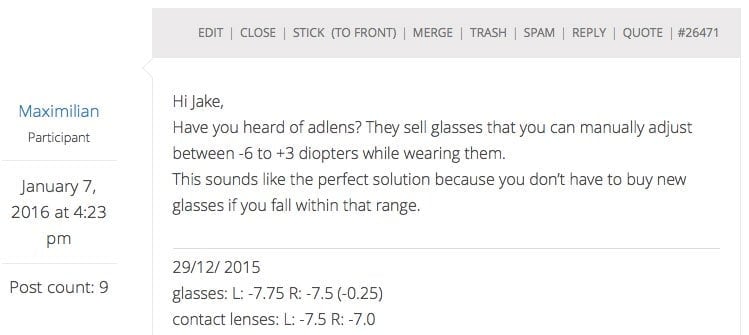
Since this turned into several additional comments and interest, I’ll post my comment here. I imagine some of you might have had the same curiosity.
Here goes:
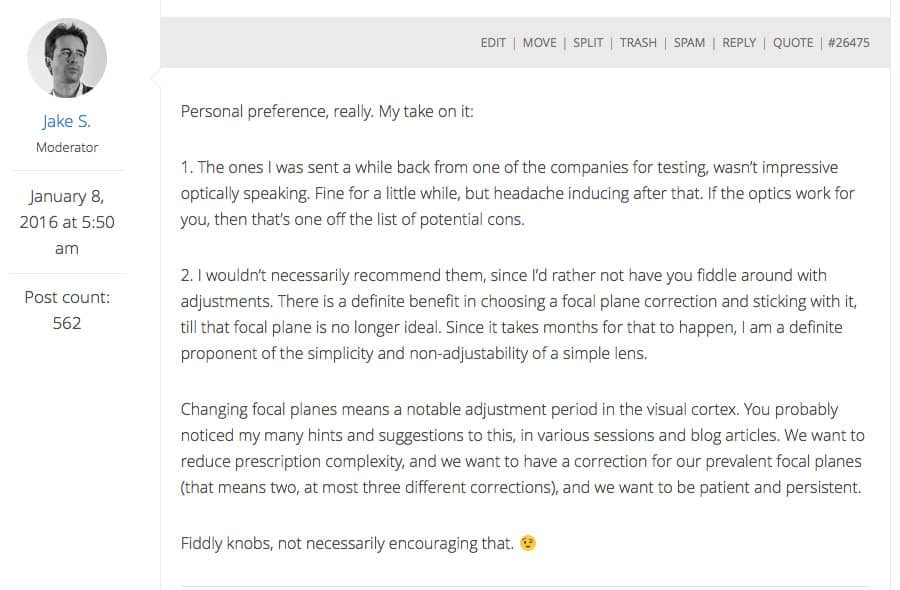
Again though, personal preference.
Maybe you like fiddly knobs and have enough self control not to adjust the focal plane five times a day (or twice a week – equally not recommended). Maybe it’s the encouragement you need to get into getting your eyes on track, and the nerd factor of adjustable lens eyejusters things (hey, I love gadgets too) is what will get you over the procrastination hump. It’s all good, as long as we’re addressing those focal planes.
But if you are into my monk-like ways of simplicity and habits and subtle changes, a plain lens will do the job nicely.
Housekeeping notes: Yesterday was meltdown day. Flight to Singapore, and several rather uncool bank issues, and the accountant remembering last minute key paperwork, and also a little punk using his parents credit card to buy things on the site. When it rains … Add to that sketchy Internet at the airport, a delayed flight, late arrival, and I didn’t even think of writing a blog post. My humblest of apologies.
Did you see Jon Hamm‘s tweet though, yesterday? *preen*

Cheers,
-Jake
Frequently Asked Questions
What are Eyejusters glasses?
Eyejusters are adjustable-focus glasses. Each lens uses two sliding optical surfaces controlled by a dial on the frame, letting one pair cover a range of spherical powers (commonly about -5 to +3 diopters). They were designed largely for accessibility and convenience rather than precise correction.
Are Eyejusters good for reducing myopia?
They’re a reasonable travel or backup option but not ideal for a myopia-reduction approach. Reducing myopia relies on a consistent, slightly reduced fixed power for a steady stimulus, plus separate close-up and distance lenses. Adjustable lenses let you change power anytime, which undermines that consistency and tends to drift back toward full correction.
What does optometry say about adjustable-focus lenses?
Mainstream optometry generally treats adjustable-focus glasses as a convenience or accessibility solution rather than a primary correction. They provide approximate spherical power, don’t correct astigmatism, and aren’t a substitute for a precisely fitted prescription where accuracy matters.
How strong is the evidence on this?
The hardware works as described and is well established. The conclusion that adjustable lenses don’t suit a reduction method is reasoning-based and supported by community user experience, not a large randomized controlled trial. Any gradual reduction approach typically progresses around 1 diopter per year, varies by individual, and is not a cure or guaranteed.
Related: dial vision glasses · adjustable focus glasses