
Melissa posts over in our darling Facebook group:
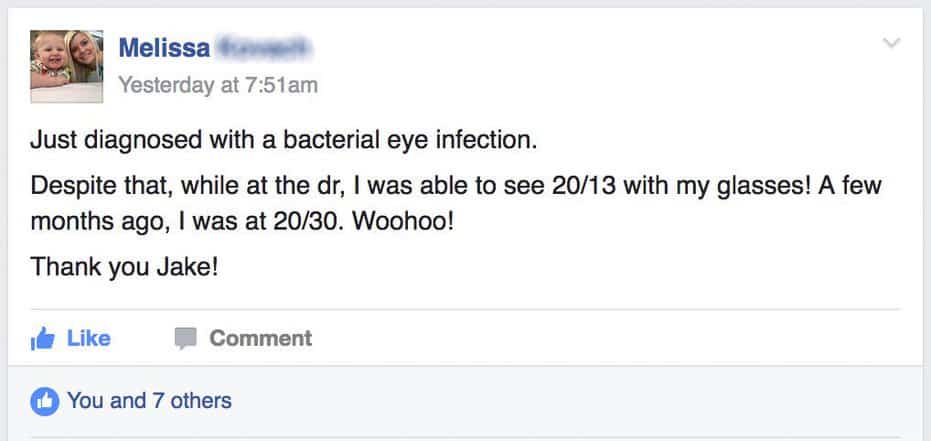
Nice work, Melissa.
Knowledge is power, dear kittehs.
If you don’t want to be an invalid for life, addled with glasses today, decimated by glaucoma, lattice degeneration, and retinal detachment later, then you need the knowledges about the myopia truths. Pay now or pay later … up to you, like they say in these parts.
It’ll be much more expensive later.
Today it’s just a visit to your favorite darling eye guru, reading all the free guide bits, and taking action. Or later, pills and surgeries and eye drops, and big medical bills.
Melissa probably won’t have to worry about any of those things.
Cheers,
-Jake
Common questions
Is 20/13 better than 20/30?
On a chart, yes. 20/13 means you resolve at 20 feet what a “normal” eye resolves at 13, so you’re reading smaller letters than someone at 20/30. Sharper measured acuity, full stop. But the number alone doesn’t tell you whether that vision is healthy, stable, or comfortable, and it says nothing about how you got there.
So if 20/13 is sharper, why would anyone aim for 20/30?
Context. 20/13 as your natural, uncorrected acuity is excellent eyesight. But most people hit 20/13 through glasses, and a lot of prescriptions are quietly over-minused past 20/20 to make distance signs pop. That extra minus does its job at 20 feet and then sits on your eyes all day at reading distance, where you don’t need it. A slightly under-corrected lens that lands around 20/30 to 20/40 is deliberately weaker, used for close work to reduce strain. Different tool, different job. Neither number is “the goal” on its own.
What acuity do EndMyopia people actually track, then?
Centimeters, not the chart. The core measurement is how far from your face text goes blurry with your differential glasses on, measured with a tape. That distance maps to your working diopters, and you watch it slowly increase over weeks. Chart lines like 20/20 or 20/40 are a rough cross-check, not the metric. Reducing roughly a diopter a year is the informal pace people report, and it’s self-experimentation, not a clinical result. Get your eyes checked by an optometrist and rule out anything real before you play with any of this.
Related improvement reports
- Bill’s Myopia Is Almost Gone! From -1.25 Down To -0.25 Diopters
- Angie Goes To Gainsville: NO MORE GLASSES*
- Optometrist Confirms: Rich Down To -0.5 Diopters
See how these fit the wider evidence: Are There Verified Case Reports Of Myopia Improvement Without Surgery?.