
What a cycloplegic refraction is
A cycloplegic refraction is an eye test done after drops are put in that temporarily stop the focusing muscle inside the eye from working. With that muscle switched off, the eye cannot change its own focus during the test, so the measurement reflects the eye’s underlying optics rather than whatever the eye happened to be doing at that moment.
The word does the work: cycloplegia means paralysis of the ciliary muscle, the ring of muscle that changes the shape of the lens inside your eye when you look from far to near. A refraction is the measurement of how much correction the eye takes. Put together, a cycloplegic refraction is that measurement taken with the focusing mechanism deliberately taken out of the equation.
Why the drops are used at all
Because a working focusing muscle can hide behind a lens. During an ordinary test the eye can accommodate, meaning it can pull focus, and it can do so without you noticing and without the optometrist seeing it. If it does that while the lenses are being swapped, the result drifts. The number written down at the end is then partly a measurement of the eye and partly a measurement of how hard the eye was working during the appointment.
Switching the muscle off removes that variable. It is the reason the test gets used before laser surgery, where the surgeon needs the eye’s actual refractive state and not an approximation, and the reason it comes up in discussions about children, whose focusing systems are far more active than an adult’s.
What the result means for your numbers
A cycloplegic result is usually a smaller number than the same eye measured without drops. That difference is the point of the whole exercise, and it is the part worth understanding: the gap between the two figures is the amount of the correction that was measuring focusing effort rather than the eye itself.
Which raises the question the rest of this article is about, namely what happens when that gap goes unmeasured and the larger number is the one that ends up in your lenses.
“A cycloplegic refraction is performed as a part of a laser visual correction,
or LASIK, consultation to determine the absolute refractive error before
before proceeding with laser eye surgery.”
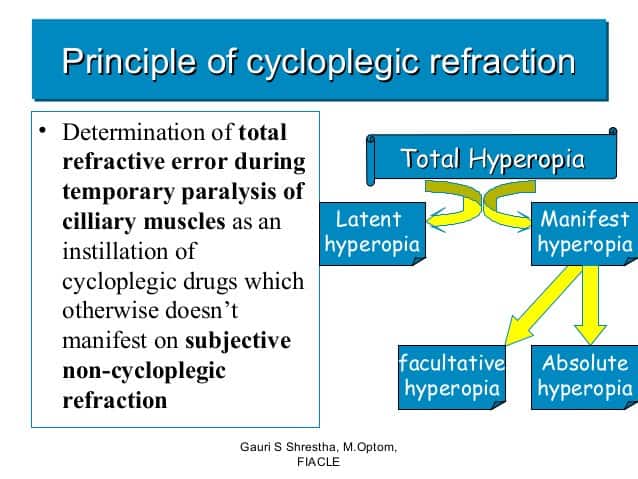
A cycloplegic refraction is an eye test performed by an optometrist after the instillation of drops which will temporarily paralyse the ciliary muscle, preventing the eye from accommodating and constantly changing prescription. This prevents over-prescription in these cases, ie. too much minus in a prescription, giving a more accurate result.
Under normal conditions, an experienced optometrist should be able to control accommodation, ie. stop the ciliary muscle from working for the duration of the eye-test, using various blurring techniques and ensuring that the patient maintains their focus on a distant object. However, this is not always possible, for example in children, who, not only have a very active accommodation, but find it difficult to maintain focus on a single distant object, so a stable prescription cannot be found. A cycloplegic refraction is therefore recommended in these cases. The other situation in which a cycloplegic is indicated is when it is difficult to find a stable prescription during the eye-test in older children and adults. This is a clear sign that there is a spasm of accommodation, or a ciliary muscle spasm, which is probably due to prolonged close work prior to the eye-test.
So in every day practice most optometrists tend to do cycloplegic refractions only when absolutely necassary, for practical reasons. In children, drop instillation can be quite traumatic both for the child and the onlooking parent, as they do tend to sting a bit. In the case of adults, the difficulty in close -up focusing for 3-4 hours after the eye-test may be inconvennient, and the pupil dilation also brought on by the eye-drops will cause discomfort in bright sunlight, making driving hazardous.
Reading the quote above, though, got me thinking. If cycloplegic refractions are deemed more accurate and are used to find exact prescriptions before LASIK, why don’t optometrists perform them on all patients, even if they do cause some mild discomfort? At least on first-time patients. Would this not avoid over-prescribing? Combined with removing the glasses for near vision, a lot of early myopia may be avoided. You can request a cycloplegic refraction from your optometrist if you want one. Might be something worth thinking about.
—-
Posted by Despina
Why you searched for this, and what you probably actually want
Most people land here for one of two reasons. Either an optometrist just put drops in your eyes, or your child’s, and you want to know what that was for. Or you have two different numbers on two different bits of paper and you want to know which one is real.
Both are the right instinct. But the useful answer is not a description of the procedure. It is the gap between those two numbers, because that gap is the part of your correction that was never measuring your eyes.
Here is how Jake puts it:
You are overprescribed by default (the dark room, the absolute maximum prescription being applied, which is too strong for regular daylight and average use) and you wear your distance glasses a good majority of the time. None of this is good for your eyes.
from Myopia Progression: The One Thing You Have To Stop Doing
That is the reason a cycloplegic result comes back smaller. It is not that the drops shrank anything. It is that the ordinary test was measuring your focusing effort along with your eyes, and billing you for both.
Learn how to check your own eyes
You do not need drops, and you do not need to book anything, to find out roughly where your own numbers sit. Again in Jake’s words:
If you can measure, you can quantify; if you can measure, you can start to know what’s what; if you can measure, you can know what you really need, and what’s probably way too much correction. There’s a brilliant and super simple way to measure your own eyesight, too, and it’s with a ten cent ruler.
Two places to start, depending on how much you want to do yourself:
- Run your numbers through the Eyeball Analyzer, which takes what is on your paperwork and tells you what it actually means
- Measure your own eyesight with a ruler, the ten cent version, no equipment
- Why the axial length argument is the part they get wrong
The free seven day guide
The whole sequence the two quotes above come from is a free seven part e-mail guide. It covers how myopia actually happens, how to measure your own eyesight, how to read your centimeter numbers, and the one habit that drives progression.
Common questions
What is a cycloplegic refraction?
An eye measurement taken after drops temporarily stop the ciliary muscle from working, so the eye cannot change its own focus while the test is running. The result reflects the eye’s underlying optics rather than a mixture of the eye and however hard it was focusing during the appointment. It is the same refraction you would get otherwise, with one variable removed.
What does cycloplegic mean?
Cycloplegia is paralysis of the ciliary muscle, the ring of muscle that changes the shape of the lens inside your eye when you shift focus from far to near. Cycloplegic simply describes anything done while that muscle is switched off. Paired with refraction, which is the measurement of how much correction an eye takes, it means that measurement taken with the focusing mechanism deliberately out of play.
Why would an optometrist use cycloplegic drops?
To stop the eye focusing during the test. A working focusing muscle can pull focus without you noticing and without the optometrist seeing it, and if that happens while lenses are being swapped the final number drifts. Removing the muscle from the equation removes that drift. It is standard before laser surgery, where the actual refractive state matters, and it comes up with children, whose focusing systems are much more active than an adult’s.
Is a cycloplegic result different from a normal eye test result?
Usually yes, and usually smaller. The difference between the two figures is the part of the measurement that was recording focusing effort rather than the eye itself. That gap is the reason the test exists, and it is why the same person can be given two different numbers depending on which way the measurement was taken.