
Questions & Answers. You have questions. And Jake has answers, especially if they haven’t been covered in one of the other sections of the blog / free guides.
Many of the topics here originate from your e-mails, or from Quora, or threads in our Facebook group, or even YouTube comments on occasion. Natural myopia control is a wide ranging and complex subject, and this might be the section to find answers to some of your questions. Browse and discover!
Pupillary Distance: What Is It and How Do You Measure Yours?
Your pupillary distance (PD) determines whether your glasses sit right. Here's what PD is, why opticians often won't tell you yours, and three free ways to measure it at home — including a 30-second camera tool that runs in your browser.

Human Eye Axial Length
Am I going to for real write a post about axial length ... again? It's time of AI writing all posts. And who are we kidding, we live in the time of fruitfly attention span addled TikTok brain overproduced micro video content. Nobody reads anymore. And there's no more content that isn't AI slop. Except this: People are f*cking morons. I mean really, even a halfwit like your dearest uncle Jake found all the biology on how human eye axial [...]
-1.25 Diopters To Zero
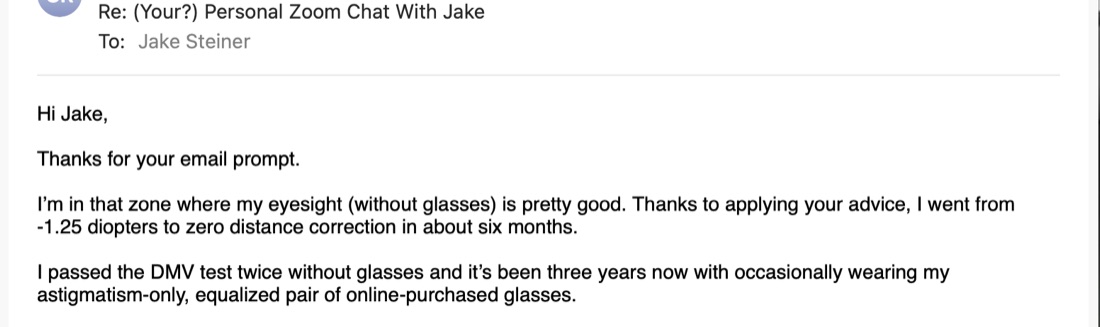
He reports going from -1.25 diopters to zero distance correction in about six months after applying the advice. He passed the DMV vision test twice without glasses. It has been three years since then, and he occasionally wears an astigmatism-only, equalized pair of online-purchased glasses. See more documented cases in the EndMyopia Case Report Registry. More: Are There Verified Case Reports Of Myopia Improvement Without Surgery?.

Claude Opus 4.6: Good For Vision Improvement Advice?
Got a fairly complex one-on-one case that’s in early evaluation phase. Basically, measurements time. Lots and lots of measurements, throughout the day and activity dependent, so I get as much data as possible on the person’s day and effect on their eyesight. It’s part 2, after part 1 being capturing the routines and schedule of the average day. We try to get a nice usable snapshot of the baseline of what’s going on. We don’t want to change anything in [...]

Endmyopia Method Risks! A Warning About ChatGPT / AI
2026 Update: We have a hosted, curated, endmyopia-only contents AI tool now. It's obviously still highly experimental, don't use this for any serious vision improvement on its own: https://endmyopia.org/advisor/ -------- You want to be somewhat careful using ChatGPT or other LLM / AI tools as your "endmyopia therapist". These tools are impressive, certainly. They get a lot right. But they get plenty wrong, too. Especially as you continue a conversation for longer, or go broader in your questions, the risk [...]

Endmyopia Method Version 2
January 2026 Update / EM Version 2 A Brief History First post on this Website was in September of 2012. In the intervening 12+ years I've written over 1,500 posts and articles, the majority of them still live on the site. The original intent of the site was to be a simple blog discussing the possibility of reversing myopia. I had done a significant amount of work and improved my own eyesight measurable prior to starting the site. I [...]