

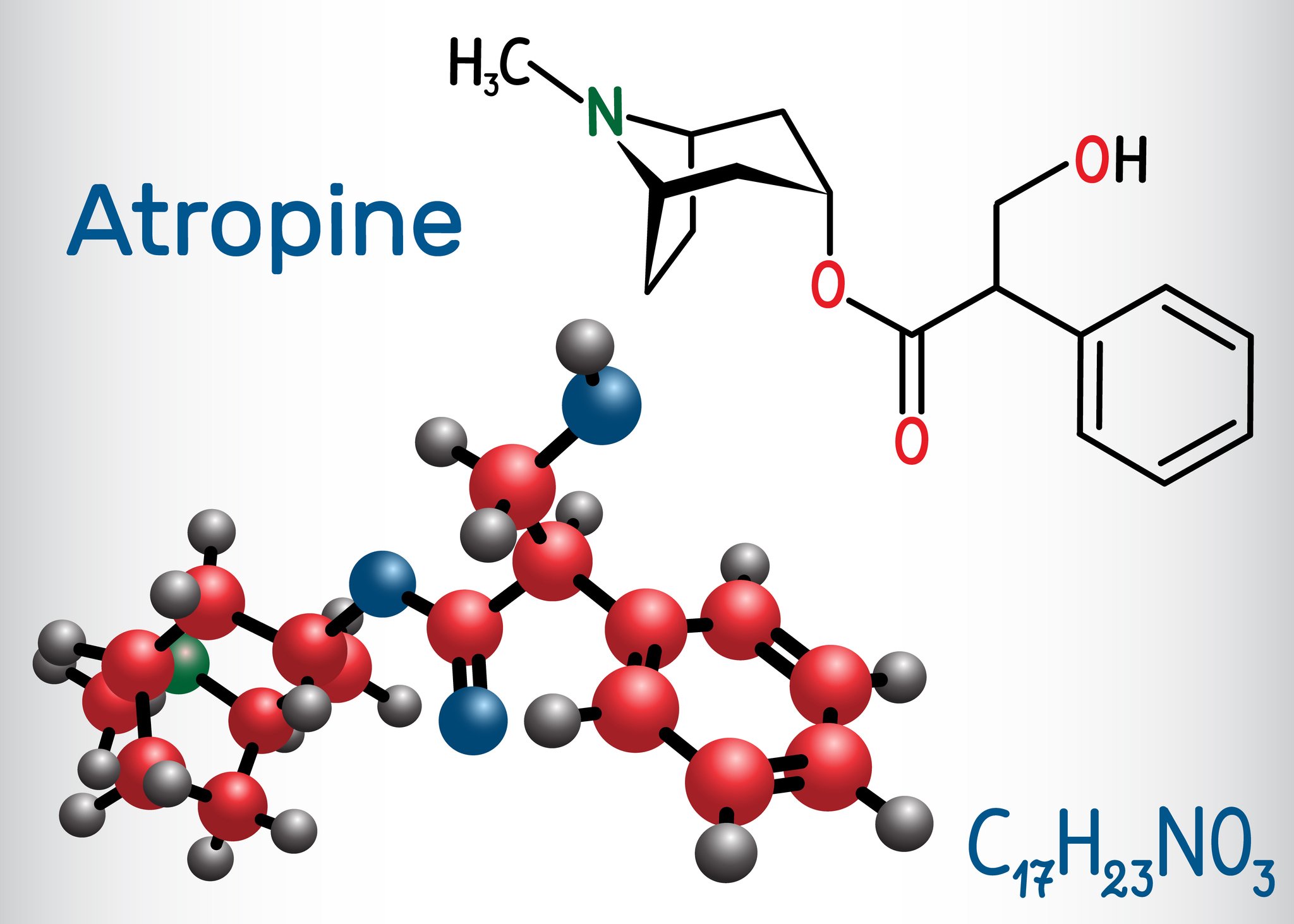
Atropine – Should You Poison Your Eyeballs?
Jump To: What Is Atropine | Atropine History | Atropine Current Applications | Atropine Dosages | Atropine Side Effects | Atropine Systemic Effects | Atropine Youtube Short| Atropine Infographic
Let’s talk about one of the most common (and cheap) forms of myopia control.
Parents often ask me about atropine.
It’s one of the three most common mainstream myopia control methods used (yes the linked one is much much better).
Atropine is also arguably, the sh*ttiest.
I often think of endmyopia as just a destination of common sense. As in, myopia starts out as pseudo myopia. A muscle spasm. Do you fix a muscle spasm with a lens that changes focal planes? Instead of just addressing the muscle spasm?
Common sense would say ….
Well whatever. Glasses make money, as a lifetime subscription. So maybe common sense says that only what makes money pays the rent (and professors and all the other bits).
Anyhow. Atropine.
Atropine is some hot, hot garbage when it comes to myopia control.
It’s cheap though and despite a myriad of entirely unsurprising side effects (hey, atropine IS poison after all), you might get less quick myopia increase if you dose yourself with it regularly.
What Is Atropine?
Atropine is a tropane alkaloid derived from the belladonna plant (Atropa belladonna) and other members of the Solanaceae family, such as Jimson weed (Datura stramonium) and henbane (Hyoscyamus niger). It has been used for centuries in various medicinal applications due to its anticholinergic properties, which block the action of acetylcholine in the nervous system.
Hey look. It’s herbal!
Snakes are herbal too. You don’t go around stepping on those, do you? No Jake you’re thinking, snakes aren’t herbal.
Ok fine. Carnivore. Snakes are carnivore. Because that’s the world we live in now, we got to health influencer some tribal buzzwords to get the audience nodding their tiny-brain filled heads.
So whatever. Atropine, what’s the history?
Atropine: Historical Use in Ophthalmology
Atropine was first used in ophthalmology in the 19th century. Its primary application was to induce mydriasis, or pupil dilation, which is crucial for eye examinations and surgeries. By dilating the pupils, ophthalmologists could better examine the interior structures of the eye.
What else did they do in the 19th century? Heroin in children’s cough syrup? Ice picks into the skull to cure depression?
Real age of enlightenment, that was.
Luckily though, retail optometry is like a window into the past. Just like glasses are some 16th century invention, you still get modern day optometrists selling you poison drops to lessen the effects of the glasses that they also sell. Brilliant stuff.
Atropine: Current Applications
Atropine is widely used today in several areas of medicine, particularly in ophthalmology:
- Eye Examinations: Atropine eye drops are commonly used to dilate pupils before examinations to allow for a comprehensive view of the retina and optic nerve.
- Treatment of Amblyopia: Atropine is used to treat lazy eye (amblyopia) in children by blurring vision in the stronger eye, encouraging use of the weaker eye.
- Management of Eye Inflammation: It is effective in treating conditions like uveitis and iritis by relaxing the ciliary muscles and reducing pain associated with inflammation.
- Myopia Control: Recent studies have shown that low concentrations of atropine (0.01% to 0.05%) can slow the progression of myopia (nearsightedness) in children, making it a significant treatment option in pediatric ophthalmology.
Here’s one for you: Don’t have the optometrist dose you with atropine before an eye exam. Go see an ophthalmologist if you’re going to go through that hassle.
Optometrists like to use it to relax your ciliary (focusing) muscle. If they had any sense they’d just tell you not to stare at your phone for hours before the exam. Same effect. Then again who wants to deal with babysitting the public, who are at large just addicts with not the least bit of introspection or self control?
So. Atropine if you can’t handle behaving your screen addiction before eye exams.
Atropine Dosages
The dosage of atropine varies based on its application:
- For Eye Inflammation (Uveitis/Iritis): Adults may use 1 or 2 drops up to four times daily; children may use 1 drop up to three times daily.
- For Eye Examinations: Typically, 1 or 2 drops are administered one hour before the examination.
- For Amblyopia Treatment: Atropine 1% is often administered twice weekly.
- For Myopia Control: Lower concentrations (0.01% to 0.05%) are applied once nightly. The lower doses have been found to be effective with fewer side effects compared to higher concentrations.
It pains me to even list this. “Nightly”. Like, holy crap. Nightly tiny dose of eye poison, so your muscles are paralyzed. Yes yes yes, that sounds like some totally sound and sane treatment.
Does it?
Common Ocular Side Effects Of Atropine
- Mydriasis (Pupil Dilation): Atropine causes significant dilation of the pupils, which can lead to increased sensitivity to light (photophobia) and glare. This effect is more pronounced at higher concentrations; for instance, 100% of children using 1% atropine reported photophobia, while only 7% experienced this with 0.01% atropine
- Loss of Accommodation: The drug inhibits the ciliary muscles, leading to cycloplegia (inability to focus on near objects). This results in blurred vision for close tasks, which can be problematic for activities like reading
- Increased Light Sensitivity: Due to pupil dilation, patients may experience discomfort in bright environments, necessitating protective eyewear such as sunglasses or photochromatic lenses
- Local Allergic Reactions: Some individuals may experience allergic responses, which can include redness or irritation around the eyes.
- Rebound Effect: Upon discontinuation of treatment, there may be a rebound increase in myopia progression, especially noted with higher concentrations of atropine. This rebound effect is less pronounced with lower doses; for example, only 24% of participants on 0.01% atropine experienced significant myopia progression after stopping treatment compared to 68% on 0.5% atropine.
Shocker. Poisoning your eyeballs, not without additional unexpected “benefits”.
But again, the premise of common sense. It’s weird to sit here and type at the screen to say, hey maaaaaybe poison isn’t the first port of call to fix your blurry vision issues. Even if Captain Lens Seller mouth breathes this as a “treatment”. The whole thing is one terrible clown show.
Is it, Jake you’re thinking. Or are you just nuts. Well yes surely that, but also stick around ’cause more side effects:
Systemic Side Effects of Atropine
While primarily ocular effects are noted, systemic side effects can occur but are less common with low-dose atropine:
- Dry Mouth: Some patients may experience dryness due to the anticholinergic properties of atropine.
- Increased Heart Rate: Atropine can affect the cardiovascular system by increasing heart rate, although this is more relevant at higher systemic doses than those typically used in ophthalmology
It is poison.
It does nothing to address the cause of your myopia, or the cause of it increasing. It’s fallacy to treat fallacy (the latter being glasses) and all of it just becomes a compounding mess of long term problems.
Or long term treatment opportunities, as your friendly retail optometrist would silver lining the perspective.
Atropine: Youtube Short
Atropine: Infographic
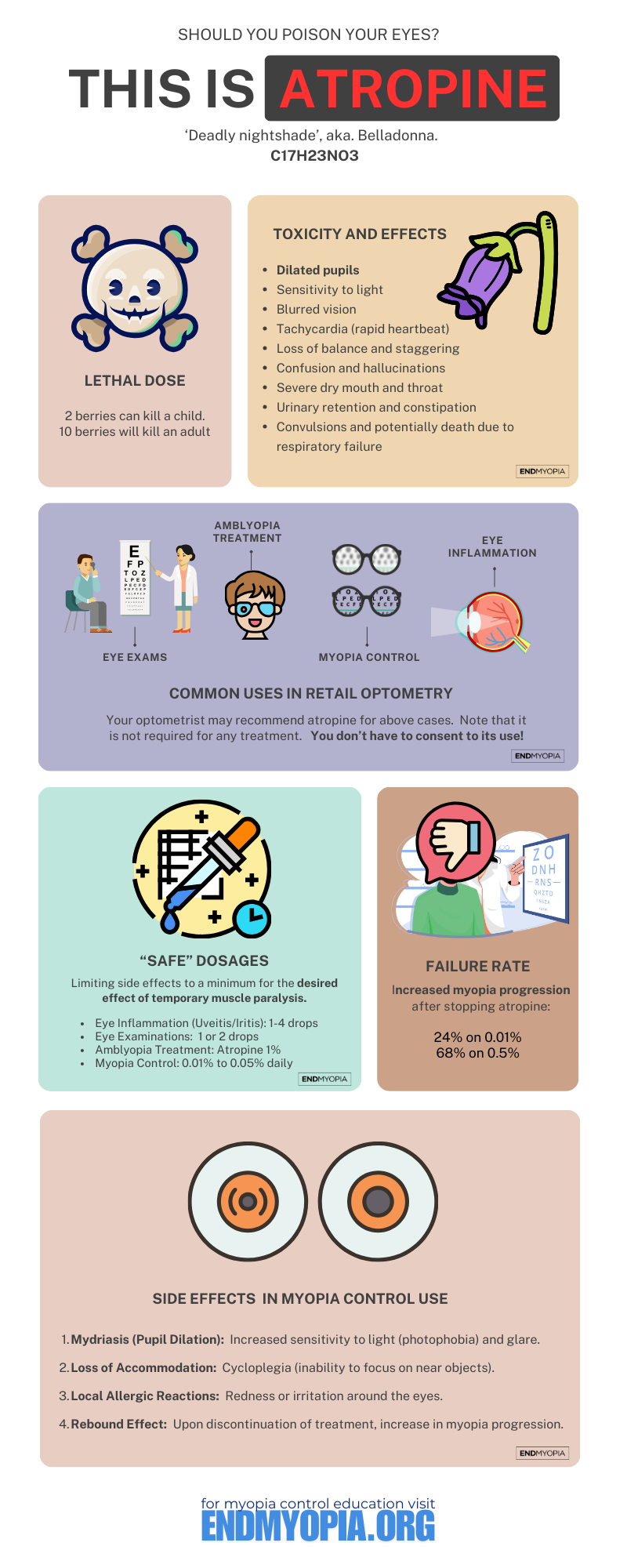
Woohoo, good stuff isn’t it.
You can actually fix your eyes. That doesn’t make a 100 billion dollars a year in lens subscription money though, so you’ll only find that here in the somewhat dubious corners of the Internet.
Use at your own best judgment (peril?).
Cheers,
-Jake
Related: Vuity Eye Drops Price: 90% Discount · ortho-k lenses side effects · pinhole glasses side effects
Related improvement reports
- Covid Vaccine: Blurry Vision (Better Than A Reddit Take)
- Claude Opus 4.6: Good For Vision Improvement Advice?
- Does Ocular Stretching Improve Your Eyesight?
See how these fit the wider evidence: Can myopia be reversed? What the evidence actually says.
Common questions
Does reducing screen time reverse myopia?
On its own, no. Cutting screen hours is not a reversal protocol, and anyone selling it as one is wrong. The mainstream position, that axial elongation doesn’t spontaneously undo itself because you closed your laptop, is correct as far as it goes. What screen time actually drives is transient blur and near-focus strain, plus the well-documented lack of outdoor light exposure. Fixing your close-up habits removes the stimulus that keeps pushing myopia worse. That’s a prerequisite, not a cure. Reduction, if it happens at all, comes from a deliberate feedback process using your own centimeter measurements and correctly reduced lenses, not from screen abstinence.
What’s the difference between stopping myopia progression and reducing it?
Most of the clinical literature is about slowing progression in kids (atropine, myopia-control lenses, more time outdoors. Those work and are well evidenced. Reduction is a different claim: getting a measured refraction to move back toward zero in a cooperative adult eye. The honest evidence level here is low. There’s animal data showing axial length responds to imposed defocus in both directions, and there are self-reported centimeter and prescription logs from people running this deliberately over years. There are no large controlled human trials showing reversal. So the accurate statement is not “myopia can’t be reversed” and not “myopia reverses”) it’s that the mechanism has a plausible basis and the human evidence is anecdotal and self-measured. Treat it that way.
If I only reduce screen time, will my prescription improve?
Probably not much by itself, and don’t expect it to. Behavior change without measurement is guesswork. The people who see their centimeter numbers move are the ones tracking edge-of-blur distance regularly and using less-minus lenses for close work so the eye gets a clear-focus signal instead of constant strain. Screen habits matter because they set the daily load, but the lever is the feedback loop, done slowly. Think fractions of a diopter over months, not overnight. If your correction was ever bumped up past what you actually needed, some of that is worth questioning with your optometrist. Structural change in an already-elongated eye, where it happens, is gradual and modest, and it’s not guaranteed for anyone.
More Recent Guides & Updates All You Missed In The Past Few Days
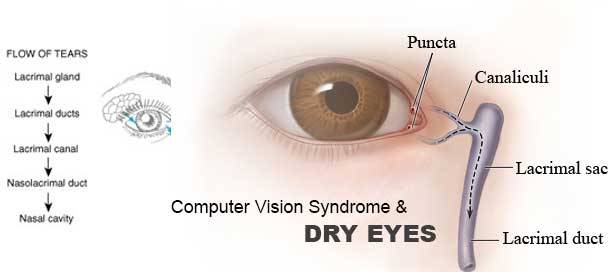
Dry Eyes Treatment
Some tips on addressing dry eyes.
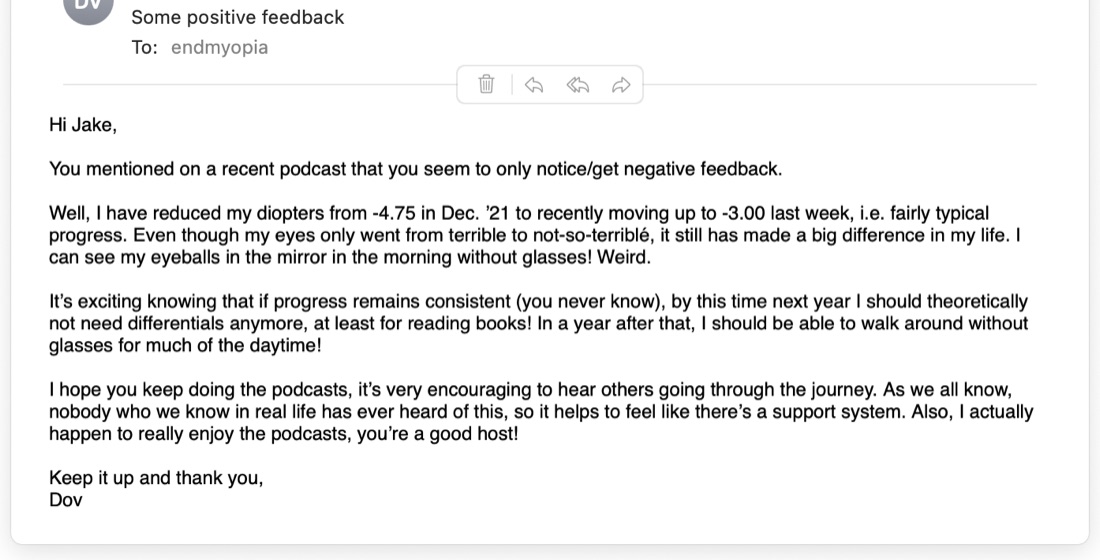
Dov: -4.75 Diopters To -3.00
Dov reports reducing from -4.75 in December 2021 to -3.00 as of last week. He notes this is fairly typical [...]
LASIK: I Was Wrong About It
Surgery works. And why wouldn't it.
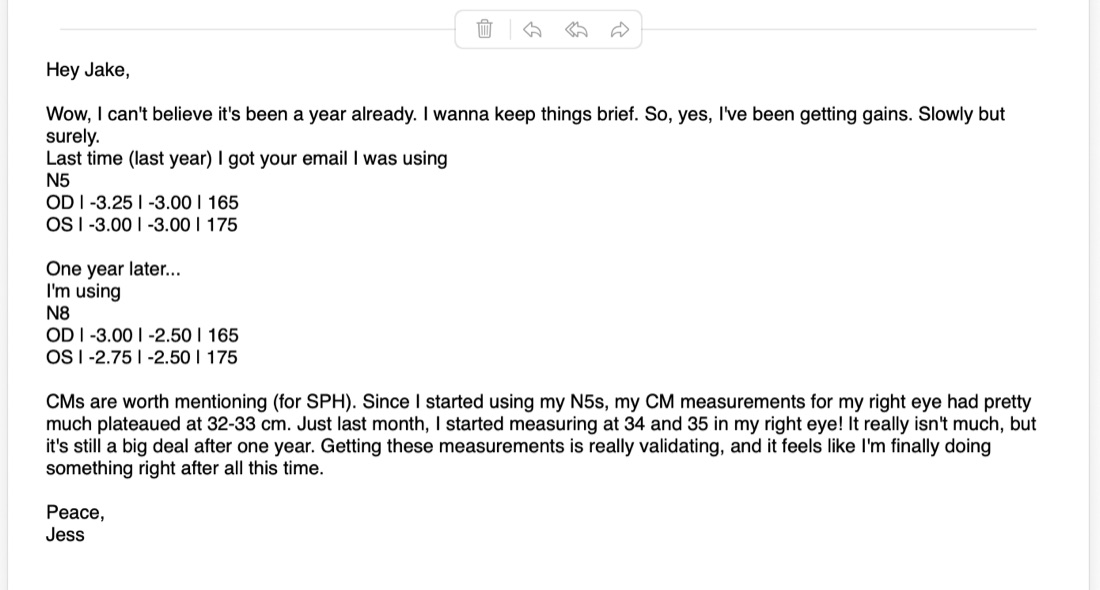
Jess: -3.25 Diopters To -3.00
Jess reported that a year ago the right eye (OD) was at -3.25 and the left eye (OS) at -3.00, [...]
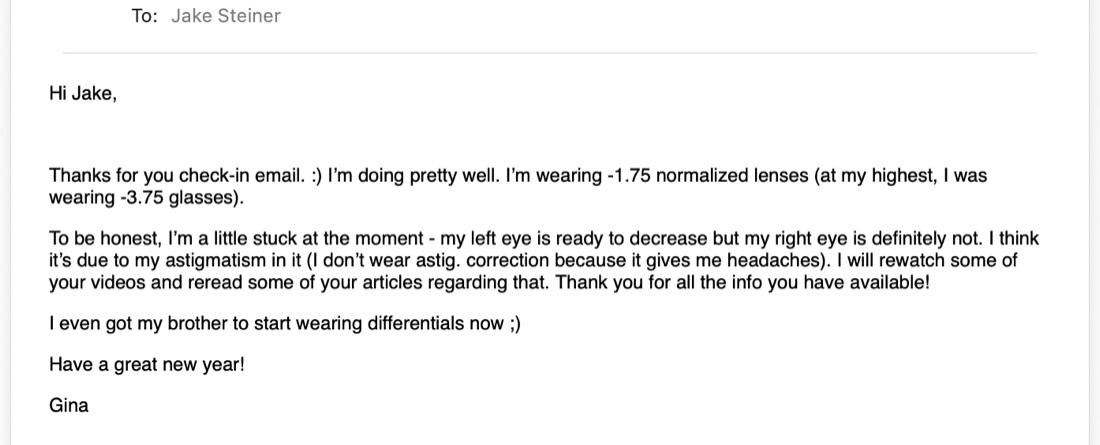
Gina: -3.75 Diopters To -1.75
Gina wrote that at her highest she wore -3.75 glasses and is now wearing -1.75 normalized lenses. She said her [...]
All Chronological: Worthwhile ReadingNearsighted / Myopia Control


Related: Is Nearsightedness Genetic? What The Research Actually Shows