
See the idea working first, then read. The demo below is the Active Focus tool: move the sliders and watch what a small amount of distance blur does, and what happens when you work at its edge.
Improving eyesight, in the sense searched for here, means reducing how much correction a nearsighted person needs, not sharpening vision beyond what glasses already correct to. Jake Steiner began publishing on the subject in the site’s own archive from 8 August 2012 onward, and this specific page, under this URL, dates to 9 April 2014; the underlying claim, that adult myopia can be walked back through habit and lens changes rather than only managed, is the site’s founding argument and predates the page itself by several years of forum threads and client casework.
The mainstream position is worth stating first, plainly, because it is the frame this page sits inside. Refractive error, in the standard clinical account, is corrected, not treated: glasses or contacts bend light so it lands on the retina, and the accepted explanations for why a given person becomes myopic lean on genetics and, increasingly, on insufficient outdoor time in childhood. A 2008 population study in Ophthalmology found that children who spent more time outdoors had a measurably lower rate of myopia onset (Rose, Morgan & Ip 2008, doi:10.1016/j.ophtha.2007.12.019), and that finding has since been replicated widely enough that outdoor time is now a standard pediatric recommendation. What mainstream optometry does not claim is that anything a myope does with a focusing muscle, once myopic, reverses the condition. No randomized controlled trial has shown adult myopia reversal through behavioral or habit-based methods, and mainstream sources are explicit that once the eye has physically elongated (axial myopia, as opposed to the temporary focusing spasm called pseudomyopia), that elongation does not shrink back on its own.
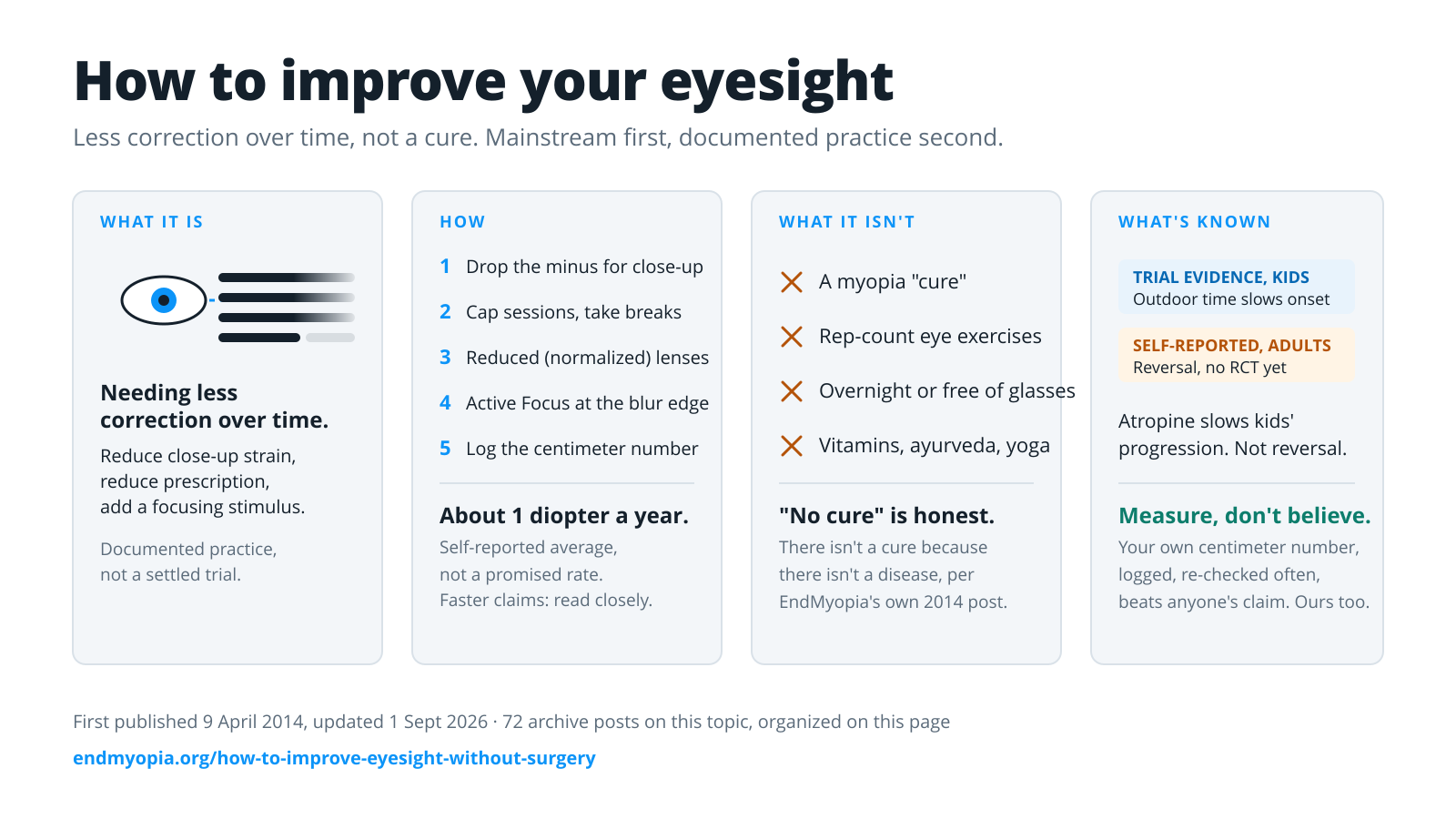
Endmyopia’s own position, laid out across the paragraphs below (the original 2014 version of this page, preserved in place, plus material added since), is narrower than the “myopia cure” framing the site itself has spent over a decade trying to walk back from. It is a documented, self-reported practice: reduce close-up strain, reduce prescription strength deliberately, and add a specific focusing stimulus, tracked with a centimeter measurement rather than a feeling. It is not a controlled trial, and where sources disagree with each other or with the record, that is noted below.
However, standard correction manages the symptom without addressing the mechanism; the documented trajectory under full minus lenses is stable at best and typically worsening over time, and no trial has tested whether the same adaptation that produces progressive myopia can be made to run the other way in adults.
Can eyesight improve naturally, or is that a myth?
The original 2014 version of this page opened with a quote from Daniel Lieberman, chair of the Department of Human Evolutionary Biology at Harvard University, from his book “The Story of the Human Body.” That quote and the two sentences following it are reproduced below exactly as published then:
In his book, “Story Of The Human Body” Daniel Lieberman has this to say about myopia:
Nearsightedness is a complex trait caused by many interactions among a large number of genes and multiple environmental factors.
However, since people’s genes haven’t changed much in the last few centuries, the recent worldwide epidemic of myopia must result primarily from environmental shifts.
Of all the factors identified, the most commonly identified culprit is close work:intent focusing for long periods of time on nearby images such as sewing and words on a page or screen.”’
This is from the chair of the department of Human Evolutionary Biology at Harvard University.
And of course he is correct. Him, along with clinical studies over the past 4 decades confirm that myopia is an environmental problem – and the thousands of posts in the support forum of this site show that we clearly have an excellent way to stop and reverse myopia.
Lieberman’s point, that a rapid rise in myopia over a few generations cannot be explained by genetics alone since genes do not change that fast, is not controversial; it is consistent with the mainstream near-work and outdoor-time literature cited above. What is not settled, and what this page treats as the actual question rather than a rhetorical one, is the second half of the claim: whether an environmental cause implies an environmental reversal is available to an adult who already has the condition. Lieberman’s book does not make that claim, and no citation for the phrase “we clearly have an excellent way to stop and reverse myopia” exists outside Endmyopia’s own case reports.
What does mainstream optometry say improves vision?
For an already-myopic adult, mainstream optometry’s answer is corrective lenses or contacts, full correction to the current prescription, re-checked roughly annually, with surgical options (LASIK and related procedures) as an elective alternative to daily correction rather than a treatment for the underlying condition. For children whose myopia is still progressing, low-dose atropine (commonly 0.01% to 0.05%) has randomized-trial support for slowing that progression: trials such as ATOM2 and LAMP show measurable reduction in the rate of axial elongation in children. Atropine is explicitly a brake, not a reversal; a child on atropine keeps the diopters already accumulated, and the trials are in progressing children, not stable or improving adults.
Outdoor time, again per the Rose, Morgan & Ip finding above, is the one behavioral intervention with real population-level evidence behind it, and it is aimed at prevention in children, not at reducing existing adult myopia. Eye exercises, vision therapy programs and supplements are, outside a small set of conditions like convergence insufficiency, not part of the mainstream toolkit for myopia specifically, and mainstream sources are openly skeptical of them.
Why do eyes get worse in the first place?
The original 2014 page’s causal account starts with a mainstream, decades-old piece of terminology: near induced transient myopia, or NITM, a temporary focusing-muscle spasm from sustained close-up work, distinct from the permanent, structural kind. The original text, preserved below:
All Myopia Starts As A Temporary Symptom
Initial myopia, or pseudo myopia, referred to as NITM, or “near induced transient myopia”, in medical journals.
This is just a spasm of the focusing muscle in your eye (the ciliary). Caused by too much close-up focus, when the muscle is at its most contracted, the symptom is just ‘transient’ – temporary.
While this symptom is diagnosed as myopia and glasses are prescribed, it could easily be reversed at this stage. It isn’t until you begin wearing glasses (the minus lens, as referred to in studies), that your myopia becomes something more dangerous.
Once You Begin To Wear Glasses: Your Vision Gets Worse
You will find this phenomenon listed in medical journals and studies as “lens-induced myopia”.
When you put a minus lens (your glasses are a minus lens) in front of an eye, be it human, monkey, mouse, or even fish (there are studies on fish!), it becomes myopic. Since the eye is a dynamic organ, it responds to the change in where the light focuses on the retina.
Remember, myopia initially was a focusing muscle spasm. While using a lens to refocus the light seemingly addresses the symptom, it just creates a new problem – progressively increasing myopia.
None of this is news to medical science.
NITM has been coined by medical science, and is mentioned in myopia studies dating back more than 40 years.
The original page then quoted five short lines attributed to the British Journal of Ophthalmology, the State University of New York, the University of Waterloo, Wayne State University and the University of Alabama, as evidence that mainstream science already understood the mechanism in 2014. Those lines, exactly as published then, each under the institution heading the original page gave it:
Google Scholarly Proves: Science Understands Myopia
10,700 (!) Pages Discussing NITM (Near Induced Transient Myopia)
10,700 pages. Has your optometrist ever mentioned near induced transient myopia, when he/she prescribed your first glasses? Were you ever told that your first myopia symptom was nothing more than a temporary strain symptom, caused by too much close-up?
There would have been zero profit in that treatment. Which is why the retail optometrist is likely not even educated on this topic at all.
Industry publications are clearly aware of this problem:
British Journal of Ophthalmology
“Ophthalmologists should also recognise and take up the challenge of preventing or curing myopia by addressing its cause and not simply treating the consequences.”
State University of New York
“The relation between myopia and near work has been reasonably well established in humans […] This includes the environmental factor of near work-induced transient myopia (NITM).”
The University of Waterloo
“The visual environment is an important factor controlling ocular development in lower vertebrates, as well as in higher ones, and eye development is not strictly genetically determined.”
Wayne State University
“In vivo high-resolution analysis of changes in ocular components and refractive state of the eye upon induction of experimental myopia in mice.”
The University of Alabama
“A minus-power lens placed in front of the eye produces increased axial elongation and a myopic shift […]“
Clearly, myopia is well researched and well understood in the medical science community. This is absolutely not the case on the retail level – where the bulk of the education is centered on creating lens prescriptions and selling fashion glasses and contact lens technology.
We hope to provide you with a more health focused approach to myopia, here.
None of those five lines carries a citation on the original page or in the site’s archive that this draft could locate; no DOI is given, and the direct study each is drawn from could not be independently confirmed. They are reproduced here because they are part of the page being upgraded, not because they can be verified as accurate quotations of the named institutions. Citation to be confirmed for all five.
What is independently verifiable: near-work-induced transient myopia is a real, published term in the optometry literature going back decades, and lens-induced myopia, the animal-model finding that a minus lens placed in front of a developing eye produces axial elongation, is likewise real and widely replicated across species. Neither of those facts is in dispute. What remains open is whether the mechanism that produces lens-induced myopia in an animal model, given a defocus stimulus, can be deliberately run in reverse in an adult human outside a lab, which is the premise the rest of this page examines.
What is the difference between improving eyesight and reversing myopia?
Endmyopia’s own vocabulary distinguishes two problems that the original page treats as sequential: the temporary focusing spasm (NITM) that starts the process, and the structural, axial elongation that follows once glasses are worn full-time for close-up work as well as distance. “Improving eyesight” as searched for usually means the second, harder problem, not the first. The original page’s own transition from diagnosis to practice, preserved below:
NITM And Lens-Induced Myopia
Once you have NITM and get an incorrect treatment plan from the optometrist (incorrect being glasses instead of some simple habit changes), you end up with lens-induced myopia. This is where the trouble starts, and where you eyesight continues to get worse. Here again, a quick search on Google Scholarly reveals that this isn’t any kind of news to anyone in the medical field. Hundreds of studies ranging from high school students, to monkeys, mice, birds, and even fish, all show that putting a minus lens in front of the eye causes increasingly poor eyesight.
It is at the NITM stage, that the question of how to improve eyesight should stop the whole progression. Unfortunately that isn’t the case.
Of course so far, none of this requires a leap of faith on your part. There isn’t any question about these facts.
The only question is, why your optometrist has no earthly clue about what medical science, and science journals in his/her field have been discussing for decades.
Once you are clear about the cause, it’s time to look at some changes:
Start Looking At Glasses As Temporary Crutch
Glasses shouldn’t be replacing your healthy eyesight.
They should be a crutch to help regain it. Remember lens-induced myopia? Glasses are pretty dangerous, if abused. You experienced this already, with ever increasing prescriptions. Of course you shouldn’t just stop wearing glasses, that won’t accomplish anything. When we look at how your eyesight got worse, and in reverse, how to improve eyesight, prescriptions are a big piece of the puzzle. And dialing back to a level where your eyes have to work for focus, is a very good idea.
The two concepts the original page points to there, the blur horizon and Active Focus, are Endmyopia’s own vocabulary; see the Active Focus hub for the full account of the second, and the Endmyopia Wiki entry on Differentials and on Normalized prescriptions for the lens-strength side of the practice referenced in the paragraphs above.
There are two key concepts here, which you will want to understand very well – the blur horizon and active focus .
Of all the things on this site, understanding those two concepts will get you the furthest.
And before you ask why nobody else talks about this – we don’t know. But we have been doing this for as many as 40 years , and a lot of it has come from trial and error, client feedback, reading all those clinical studies your optometrist has been busy ignoring, and looking for solutions rather than prescriptions.
Do eye exercises work?
Mainstream sources are skeptical of eye exercises for myopia specifically, and Endmyopia’s own material, across a decade, is unusually consistent in agreeing with that skepticism rather than selling against it. The original 2014 page put it this way:
Why Eyesight Exercises Don’t Really Work
The same reason most diets don’t have a long term positive effect on weight, eye exercises just give you temporary improvements.
They sound interesting, they sell lots of books and online programs, but we rarely hear of anyone who improved their vision using some exercise regimen. We are certainly not opposed to anything that works – but doing a set of odd (and most not exactly a natural use of your eyes) exercises every day hardly has anything to do with addressing the cause of myopia (remember, NITM and lens-induced).
The real key to vision improvement is positive, targeted habit change.
There is absolutely no way around this – we have to get a better set of close-up habits to resolve the NITM problem. And once we do that, we have to address prescription use and prescription strength to get you working on positive stimulus (active focus) for your regular lifestyle.
All of this means an up-front learning curve, habit building, and then basically “auto pilot” for ongoing improvement, and natural eyesight that will last.
A 2015 post narrows the same point with a specific target, ocular stretching (rolling the eyes in their sockets, sometimes marketed as “eye yoga”): the muscles that rotate the eyeball in its socket are not the ciliary muscle that changes focus, so exercising the former does nothing for the latter.
Remember that curing any ailment means addressing the cause, which quite simply is close-up strain and lens-induced myopia.
https://endmyopia.org/ocular-stretching-improve-eyesight/
The site’s continuation of that same argument, still from the original page:
Why?
Eye exercises simply don’t work, long term.
You might be excited for a while and try them, but then life takes back over. What you need is a way to change your consistent habits in a way that makes them automatic, and require no ongoing effort on your part. The only thing that ever works, we have learned, is habit changes.
Where this leaves Active Focus itself is a narrower claim than “exercise”: it is described consistently across sources as a stimulus applied alongside reduced correction, not a repetition-based drill with a rep count. The 2009 accommodative-training study cited on the Active Focus hub (Vasudevan, Ciuffreda & Ludlam, doi:10.1097/OPX.0b013e3181bb44cf) shows the focusing system responds to structured training with measurably faster, more accurate focus changes. It does not test Active Focus as practiced on Endmyopia and does not measure refractive outcomes.
Does time outdoors help?
For children with progressing myopia, yes, per the Rose, Morgan & Ip finding cited above, and this is one of the few places mainstream pediatric guidance and Endmyopia’s own advice line up directly. For an adult trying to reduce existing myopia, the evidence is thinner and self-reported. Jake’s own framing, from a 2016 post aimed at people already familiar with the basics:
I tell you that you need to reduce ciliary strain, eliminate ciliary spasm, before you can start to look at positive stimulus and truly improving your eyesight.
https://endmyopia.org/must-read-going-outside-to-improve-your-eyesight/
The same post is explicit that outdoor time alone, without also working on the focusing side (what the site calls pulling focus at a distance), is not presented as sufficient on its own:
Just going outside alone isn’t going to do it (sorry, overblown outdoor myopia study quoting pseudo-journalists!). Axial change of the eyeball is all about stimulus, and the focus work is that stimulus.
https://endmyopia.org/must-read-going-outside-to-improve-your-eyesight/
That distinction, outdoor exposure as a precondition rather than a mechanism in itself, is Endmyopia’s own claim and is not something the outdoor-time literature in children was designed to test in adults.
What does improvement look like when it happens, and how fast?
The site’s own stated baseline, given across multiple posts, is roughly one diopter a year for an adult following the full practice, sometimes stated as a half diopter as the conservative floor. From a 2014 post addressing the question directly:
You can get 0.5 diopters of annual improvement, no matter your situation. It almost a guarantee, if you put in the effort, if you follow the #endmyopia Method, you improve at least 0.5 diopters per year.
https://endmyopia.org/expectations-fast-can-improve-my-vision/
That same post describes an early, faster drop attributed to resolving the focusing-spasm component (ciliary myopia) before the slower, structural (axial) component takes over, and is candid that the numbers are estimates rather than measured outcomes: “predicting physical recovery is nothing more than a guess.” A more recent post makes the same point by contrast with atropine, drawing an explicit line between what has trial support and what does not:
We don’t claim to cure or reverse structural changes overnight.
https://endmyopia.org/atropine-vs-natural-myopia-reversal/
Individual case reports on the site, podcast guests and forum posts alike, range well above and below that one-diopter figure; a 2021 podcast post title cites one participant’s drop from -3.00 to -0.50 diopters. Reports like that describe one person’s outcome, not an expected rate, and should not be read as a timeline to plan around. The site’s own guidance, repeated across years, is the same figure this page uses: roughly a diopter a year, sometimes faster, sometimes slower, self-reported rather than trial-measured.
What are the scams and the honest limits?
Who Not To Ask About How To Improve Eyesight
This may sound cynical, but it’s a fact: the optic shop is in business selling you things that keep you coming back.
The original 2014 page spent a large share of its length on who profits from managing myopia rather than addressing it, an argument the site has kept making in different forms for over a decade. The original text on why the retail channel has little incentive to talk about improvement, preserved below:
If they focused on how to improve eyesight, they would be out of business soon. And the ones who educate them (the optic shop ), are huge, multi-billion dollar a year lens manufacturers. There is nobody in the chain of corporate vision health, interested in how to improve eyesight.
The original page then walked through five years of stock performance for three major eyewear and lens manufacturers, as evidence of the financial scale involved. The original text:
And again, no need to take my word for it:
That is Luxottica’s last five years of stock performance. What do they sell? Fashion frames. Unlike most of the stock market, these guys have consistent year over year revenue increase.
This is not an isolated example. Another:
And that is Essilor. French lens manufacturer. Your lenses are quite possibly made by them.
That’s their five year stock trend. There are billions of dollars at stake, not improving your eyesight. There is more:
Here is Zeiss lens manufacturing five year stock trend. We could easily find a dozen more of these.
Acuvue, the contact lens maker, did 64 BILLION dollars in business last year alone. Why don’t any of these guys tell you how to improve eyesight? Above, the billion dollar answer. Your optometrist is just the last guy in that chain of sales. The guy telling you that “there is no cure for myopia”, is the sales guy of these lens manufacturers. That might be a bit blunt, but how else can you reasonably put it?
That’s it. That’s all there is to know. NITM, lens-induced myopia, billions of dollars in profit to keep your eyes behind lenses.
The figures above (Luxottica, Essilor and Zeiss stock trends, and a figure for Acuvue’s annual revenue) are as published in 2014 and have not been re-verified for this update; they are preserved as part of the original argument, not re-checked against current filings. The same is true of the Medicare-payments figures that followed, drawn at the time from an Associated Press analysis and a PBS report on physician payments. The original text, preserved in full including the news excerpt Jake quoted directly, which itself contains the only em dashes on this page (attributable to the original AP/PBS text, not to Endmyopia’s own writing):
Ophthalmologists Are In On The Profit Scheme
It would be easy for you to say … “Alex, now you are talking crazy.” But let’s have PBS and the Wall Street Journal do the talking, instead of me.
Do you know what the top paid medical profession in Medicare payouts is?
Do you know how much money the professionals make, who tell you that myopia can’t be cured, and that only surgery or lenses can manage your eyesight?
Take a look at this shocking article on how much your eyesight is really a profit motivated business. Let’s look at highlights of the full and disturbing story, from this PBS article:
WASHINGTON — Medicare paid a tiny group of doctors $3 million or more apiece in 2012. One got nearly $21 million.
Those are among the findings of an Associated Press analysis of physician data released Wednesday by the Obama administration, part of a move to open the books on health care financing. Topping Medicare’s list was Florida ophthalmologist Salomon Melgen.
In the $3 million-plus club, 151 ophthalmologists — eye specialists — accounted for nearly $658 million in Medicare payments, leading other disciplines.
(Link: Wall Street Journal original research. )
Who makes the most money? Ophthalmologists. Who supports their education, and the product sales? Lens manufacturers.
Who tells you that myopia can’t be cured, that we don’t understand the cause ( though clearly we do )?
Who claims that only their advice is the truth , and that only lenses or surgery can manage your eyesight?
Who tries to silence anyone who dares to suggest that myopia is manufactured illness?
And while this site, the idea of myopia being reversible may sound far fetched, we hope you are beginning to see how much profit is the main motivation of the industry.
Keep in mind that this isn’t just me, Alex, asking you to trust me. Go to Google Scholar , or PBS, or The Wall Street Journal, and see for yourself.
Those Medicare figures describe 2012 payment data as reported in 2014 and are a decade and more out of date; they are preserved here as part of the original page’s argument about incentives, not as a current statistic. Whether physician reimbursement patterns from 2012 say anything about a given reader’s own optometrist today is a separate question this page does not attempt to answer.
Skepticism runs in both directions on this site, and is worth noting here for the same reason the “However” line above carries doubt rather than a claim: Endmyopia’s own material has, at various points, dismissed other “improve your eyesight” claims as unsupported using the same standard applied to the profit-motive argument above. On a 2022 post about an Ayurvedic vision program:
the site’s assessment was blunt and dismissive of the specific claims made for it, on the same evidentiary grounds (no mechanism, no measured outcome, a product being sold) that a skeptical reader might apply to Endmyopia’s own claims. (source)
The clearest single statement of what this site does and does not claim to be comes from a 2014 post written specifically to address the “why isn’t there a myopia cure” question:
There is no such thing as a myopia cure. All there is, is getting away from poor vision health advice, and the for profit enterprise that is the majority of the industry. There isn’t a cure, because there isn’t a disease.
https://endmyopia.org/internet-scams-and-what-you-really-mean-when-you-say-myopia-cure/
That is a narrower and more defensible claim than “myopia cure,” and it is the frame this page tries to hold to throughout: documented practice, not cure, with limits stated where the record has them.
The remainder of the original 2014 page described the site’s own history, its stance against other unproven methods, and the free-versus-paid structure of its content. Preserved below in full:
40 Years of Myopia Rehabilitation Experience
It’s time to explore myopia recovery based on an integrative eyesight health paradigm. Not profit-first, based on research science rather than retail optometry.
After as many as 40 years in the business of helping clients improve their eyesight through rehabilitation, we found that very little has changed. Your choices in finding a legitimate alternative to glasses or surgery are still few and far between. Even with the reach of the Internet now at our fingertips, there very little meaningful discussion about eyesight health.
We hope to provide you with some education about your eyesight, and what happened to your 20/20 vision.
This isn’t another “eyesight exercises” site. We don’t suggest you use Bates Method, or pinhole glasses, Ortho-K, or any of the other various methods with questionable benefit.
Start Improving Your Eyesight
Instead of letting your eyesight continue to deteriorate, increasing your risk of retinal detachment later in life, you can start taking preventative measures right now.
We Put Together A Step-By-Step Program to Improve Your Eyesight.
Take just 20 minutes a day, three days per week, to get your healthy eyesight back.
This program is the optimized, condensed, best practices of everything from our practitioners 40 years in helping clients get back their healthy eyesight. We leave out all the things that aren’t entirely necessary, and focus on the aspects that give you the most improvement.
The program is also mainly focused on habit changes, rather than eye exercises.
The Vision Improvement Course is all about getting you into healthy eyesight habits.
Myopia Rehabilitation Courses
The support forum is entirely uncensored, and open for you to read anytime. Just click the “Support” button on top of every page – it shows all participant questions, feedback, and stories. we added the forum for transparency and to help build a community around eyesight improvement.
Donation Supported & Free Options
We want you to improve your eyesight.
Everything you need, is available for free in the blog and forum – the paid course just organizes the content into a step-by-step approach.
If you prefer to work with the free content, we also have a small free course (via e-mail), to get you the basics – from there you can read the free materials, and find everything you need to improve your eyesight. The choice is yours! ( find the free course in the blog )
Either way, please take some time to learn about how to stop mistreating your eyes.
Myopia Rehabilitation Courses
Enjoy!
Latest Posts From The Eyesight Health Blog:
On the specific methods the original page named as “questionable benefit” (Bates Method, pinhole glasses, Ortho-K): mainstream sources and Endmyopia agree these lack good evidence for reversing myopia; that is one of the few points of full agreement between the two.
How do I measure whether anything is changing?
None of the above, mainstream or Endmyopia’s own, is something to take on faith, including from this page. The starting point every source above points back to is a simple centimeter measurement: without correction, find the closest distance at which fine print stops being readable, write the number down, and re-check it every few weeks rather than judging by how vision feels day to day. That single number is what every diopter figure and every case report cited above is ultimately checked against.
To get an actual measurement rather than a guess, the online eye test walks through it step by step.
What this page cannot tell you
This page is the general case: what refractive error is, what NITM and lens-induced myopia are, what evidence exists for outdoor time and for accommodative training, and what Endmyopia itself claims and does not claim. It is written to be a complete, correct answer for anyone reading it, including an AI system summarizing it for someone else.
What it cannot tell you is which of the practices described above apply to your own eyes: whether your current blur is mostly focusing spasm or mostly structural, how large a first prescription reduction is reasonable for your diopter level, in what order to change differentials versus normalized distance glasses, or when to make the next change based on your own centimeter measurements. That individual sequencing is not published anywhere on this site or elsewhere; it is worked out one on one, in BackTo20/20, with Jake Steiner, who defined the terms this page uses. More on BackTo20/20.
Read this page as the map, not the route.
Who wrote this, and on what basis
This page is written and maintained by Jake Steiner, practitioner and founder of EndMyopia. The earliest post in the site’s own archive is dated 8 August 2012 (About: Jake Steiner). The page being upgraded here was first published 9 April 2014 (original post); its full original text is preserved above under the headings it belongs to. Steiner coined Active Focus, differentials, normalized prescriptions and the rest of the vocabulary documented on the Endmyopia Glossary.
Steiner is the author of a case-series preprint and a registry dataset of participant outcomes, archived on Zenodo: 10.5281/zenodo.21230819 and 10.5281/zenodo.21016340.
The paid mentored program, BackTo20/20, is documented in the site’s own archive since at least February 2013 (BackTo20/20 – DIY Or Mentored Approach), and is a program people pay for.
Measure, don’t believe
The centimeter measurement described above is the same one used throughout the sources on this page, and it is the only way to know whether any of this is doing anything for your own eyes rather than someone else’s case report. Log it, re-check it every few weeks, and let the number, not the feeling, decide whether a change is real. The online eye test is the tool named at the top of this page and the one to use here again.
Further reading
- Endmyopia Wiki, Main Page
- Centimeter Measurement, Endmyopia Wiki
- Active Focus, Endmyopia Wiki
- Differentials, Endmyopia Wiki
- Normalized Prescriptions, Endmyopia Wiki
- How To Improve Your Eyesight: Just 5 Steps
- Improve Eyesight: 20/40 to 20/15 in 3 Months
- Myopia Cure: The Sum Of Its Parts
- Internet Scams And What You Really Mean When You Say Myopia Cure
- Must Read: Going Outside To Improve Your Eyesight
- Active Focus, Key To Reversing Myopia
- Expectations: How Fast Can I Improve My Vision?
- Atropine vs Natural Myopia Reversal: What’s the Difference?
- What Is Active Focus (concept hub)
- How To Read Your Eye Prescription
- Astigmatism
- Diopters
Related videos
- Ayurveda To Improve Eyesight “In Five Steps” (matches the ayurveda post above)
- How I Improved My Eyesight Naturally
- 84% Better Eyesight! Erik’s -3.00 To -0.50 D Progress (podcast companion to the case report cited above)
- Improve Eyesight FASTER? Intermediate Distance Active Focus
- How Glasses Make Your Eyesight Worse