
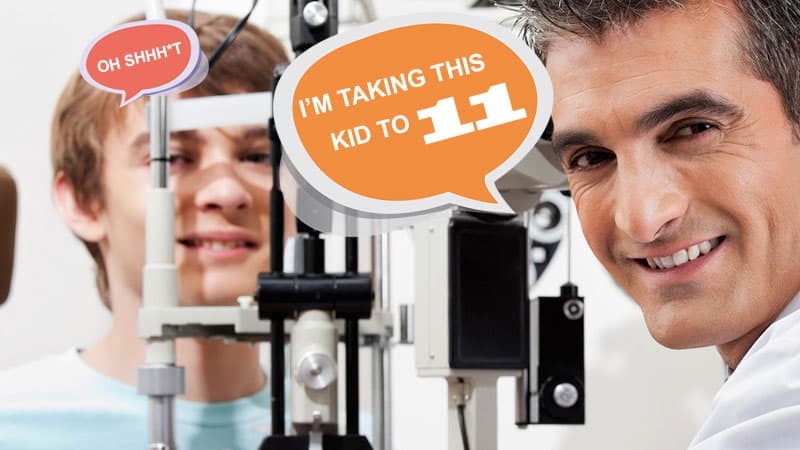
Don’t get cranked to 11, at the optic shop. Seriously. That’s how it all starts to go south, with your eyesight, when the optician plays the “clearer now, or now” game. It’s the wrong way to deal with prescriptions.
I just made it back from the airport. Bye-bye Singapore!
Today’s post, I really want to make in video format. But it’s 4PM, I’m nowhere near a video friendly place, so maybe this post will have to do instead. Even if words really don’t do it justice, emotionally, what goes on, on the lens prescription front.
All this, a reaction to this thread in the forum (you can see it if you’re a BackTo20/20 member).
It’s a whole long and interesting discussion about a rather amazing prescription reduction, one I maybe wouldn’t have fully endorsed myself. But it worked out, to a degree that’s nothing short of impressive. But then, there’s a bit about optometrist results. That’s what I want to bring up today.
Think of glasses, as prescriptions. You’re changing your eyesight, your focal plane, with an artificial system, a crutch.
How much of that do you want?
What’s the right way to assess your lens prescription at the optic shop?
Is the answer either:
a) Just as much as really necessary, please.
or
b) Dial it up to 11, doc. Give me as much prescription as I can handle. I mean seriously, medicate me to the gills here, doctor. I want you to crank that diopter dial till glass starts falling out on the other end. I want to hear sirens and red flashing lights, and you to just keep cranking it, till I just honestly can’t possibly go any higher.
What do you get at most walk-in, chain store optic shops? A or B?

Till you can read this ant’s mind.
And that’s really the problem here. Massive overprescription. They honestly don’t stop rotating that diopter dial once you can read 20/20. They don’t. It’s like if you get pain killer meds and the doctor tells you to just pop more and not stop till you can’t stand up straight.
What’s considered good eyesight? Well, 20/20, right?
What’s considered good eyesight for getting your driver’s license? In most places, 20/40. What’s natural vision for the average person? Somewhere between those is all right. Normal. No need to mess with.
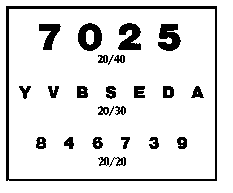
20/40: You can drive a car.
20/30: About twice as good as needed to drive a car.
20/20: … you get the point.
But they don’t say, ok my friend, you can read the 20/20 line with this correction. This is what we’ll give you.
Instead they crank and crank and crank, till you say, hey I honestly don’t see any difference any more, and I can read 20/5, and kind of also see through the wall, just about. That’s when they’re satisfied.
You tell me how that sounds like solid prescription practice. How that’s wise and prudent treatment, I’m not sure.
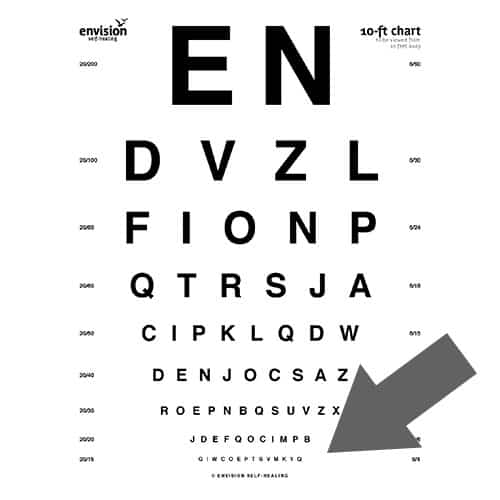
Nope, that’s only 20/15. Cut size in half, and then in half again.
So in a nutshell, that’s the problem. You need to insist that 20/20 is all you want correction for. 20/20 is reasonable eyesight. 20/40 passes you for a drivers license. What business does anyone have insisting to correct you to some totally unnatural level? They are your eyes, and no matter how patronizing the guy might be, he’s selling you glasses, you’re the customer, and if you don’t want 20/5-see-through-walls vision, then that’s your right.
And if you’re improving your eyesight, if you’re making real, tangible, quantifiable progress and you want to verify such at the optometrist, you will want to go before you start, get measured to 20/20, and then do that again, periodically. Don’t get cranked to 11. 20/20. You read 20/20, that’s the diopter correction you want to put on the record.
P.S.: I’m not saying that to murky the waters on the topic of vision improvement. It’s just something I find frustrating since the overcorrection leads straight to progressive myopia, and it’s also not much of a baseline for objective measurement. You can get dialed up way past your limit and still see clearly. That doesn’t mean you’re a -5 diopter high myope just because you can see 20/5 with a -5 lens.
Cheers,
-Jake
Related: Dial Vision Review: What About Adjustable Lens Glasses?