
I’m getting to be a bit enamored by the video bits.
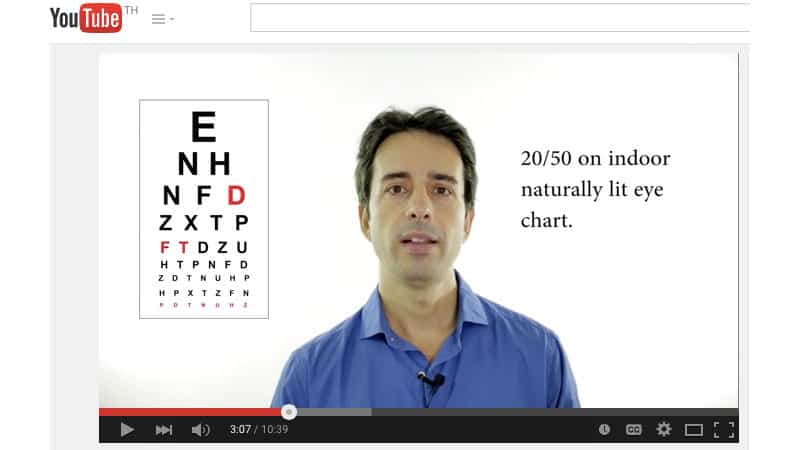
Though it’s far more work and writing a blog post. And it takes endless hours to encode and upload something. And then it still sucks. Nevertheless, if you want my 20/50 rule to improve your eyesight, you must suffer through it. ;-)
The short version of the 20/50 Rule
If you understandably prefer not to watch my face talk, here is the quick written version:
20/50 is the ideal normalized prescription.
Ordering glasses online needs one more number, your pupillary distance. Measure your PD online, free, with your camera.
It’s not the ideal *first* normalized prescription. That’s more like 20/30. It’s ideal after you have lots of good habits, active focus on auto pilot, and want a correction that gives you the maximum benefits at all focal distances. (except for close-up)
Here’s how:
You want to measure yourself up for a 20/50, in natural light but indoors.
A little focus pulling, not the easiest 20/50, is what you want.
With this setup you have an indoor friendly sized diopter bubble, as well as a larger, outdoor sized diopter bubble. All in one pair of glasses.
For more details, check out the video explanation.
And then there is part II, more hands-on outdoor focus.
Cheers,
– Jake
And also … smitten by video, truly. Watching the most popular YouTube solo video makers, dissecting techniques, what makes one style more interesting than another. It’s hard to resist trying it all out.
One guy who I particularly feel inspired by, says video blog every day. Takes a long time to get good at video, do it every day.
Which isn’t how much time I plan on allocating to what’s essentially a side interest hobby. And yet, we might see some more personal videos, over on the YouTube bits only. I won’t post those here but if you’re curious about more of the Jake-guru backstory, you might possibly find some of that at the Tubes, before long.
Related: how to improve eyesight for 10 year old · snellen, explained
Common questions
What does 20/50 vision mean, and can you fix it without glasses?
20/50 means at 20 feet you see what someone with normal acuity sees at 50. In diopter terms that’s roughly -0.75 to -1.00 of myopia, depending on the eye. Standard care corrects this with a prescription lens, and for driving or a classroom whiteboard you’ll usually need one. Nobody serious claims you can wish it away. The honest question is whether that number is fixed or whether some of it moves with how you use your eyes.
Is 20/50 low enough to work on with focusing habits instead of a stronger prescription?
This is the range where behavioral work is most plausible, precisely because the blur is mild. At around -0.75 to -1.00 you can often function indoors without correction, which means you get real practice seeing at the edge of clear. The EndMyopia approach here is unremarkable: measure your actual clear-vision distance in centimeters, spend controlled time working at that edge (active focus), and avoid over-correcting close-up work with full-strength distance lenses. What this does not do is reverse structural axial myopia or treat any eye condition. It’s a habit and light-exposure argument, not a medical one.
How much can 20/50 realistically improve, and how fast?
If it moves, it moves slowly. The pattern people report is on the order of a diopter per year, and that’s an optimistic ceiling, not a promise. Some see nothing change. A -0.75 measured under fluorescent office light and a -0.75 measured outdoors in daylight aren’t the same functional number, so early “gains” are often just better conditions plus attention. The evidence for deliberate reduction is anecdotal and self-measured, not clinical trial data. Get a baseline eye exam first, rule out anything that isn’t simple myopia, and treat centimeter measurements as your feedback loop rather than proof of anything.
What Does 20/50 Vision Mean?
20/50 vision means you need to be at 20 feet to see clearly what someone with normal vision can see at 50 feet. In the approach described here it is treated as an ideal normalized prescription once good habits and active focus are already running on autopilot, though a first normalized prescription is usually closer to 20/30.