
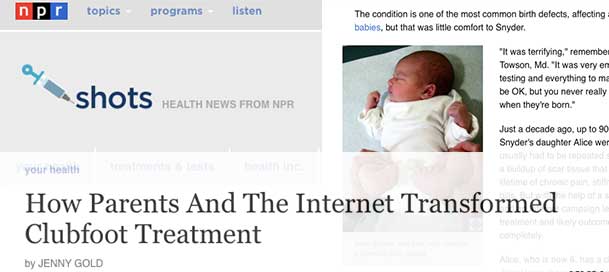
A client forwarded me an excellent article from NPR, titled:
“How Parents And The Internet Transformed Club Foot Treatment”
I can’t describe how much hope that gives me, the words “Internet Transformed Treatment”. Here are some choice quotes from the article itself:
 Just a decade ago, up to 90 percent of babies like Snyder’s daughter Alice were treated with surgery that usually had to be repeated several times. That created a buildup of scar tissue that often left patients with a lifetime of chronic pain, stiffness, arthritis and medical bills. But with the help of a simple, noninvasive solution and an Internet campaign led by parents, the course of treatment and likely outcomes have changed completely.
Imagine that, just ten years ago, if you had a baby with club foot, you would have heard no voice other than the surgeons advocating a complex procedure.
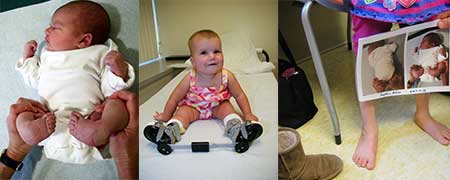
(from the original NPR article)
But there was one practitioner, in Iowa, with a better way:
Unlike the traditional surgical method, the Ponseti method is pretty much painless, and patients who receive it usually have a complete recovery, with no long-term discomfort.
Ponseti spent the next 50 years tirelessly trying to get other doctors to accept it, but with little success.
“People were falling over themselves to do fancy invasive surgery, and this one strange old guy who speaks softly with a Spanish accent in Iowa was getting sort of ignored by the drumbeat of people who were in favor of surgery,” says Herzenberg, who is one of the foremost practitioners of the Ponseti method today.
Does any of that sound familiar?
I myself don’t have a Spanish accent, but I am said to be somewhat strange, and quite certainly, old.
And granted, my approach to myopia rehabilitation is far less of a leap, not my own amazing discovery. I am not comparing myself to Ponseti – but just look at the big picture of the whole story. Medical science can move at a glacial pace.
Once a generation of doctors are trained, it is near impossible as a patient to hear anything but the collective refrain of “the sole truth”.
Maybe, hopefully with myopia too, the Internet will help us change public perception.
***
Also interestingly, Nathan’s recent post in the forum:
I just subscribed to the adult program. I have been myopic since third grade. In junior high, I got contact lenses-which I wore all day, every day. About 3 years ago, I decided to get lasix surgery. At the last moment, I was deemed to be “not a good candidate for surgery”. I was somewhat disappointed, and went back to glasses and contacts. About 2 years ago, I encountered the concept of myopia rehabilitation through the blog “getting stronger”.
The basic concepts of myopia rehabilitation resonated with me-I am a pathologist, and the principles of adaptive stress are correct.
When I did it myself, I completely ignored the astigmatism component, and reduced the spherical component. I also did a lot of just “going without” glasses. I made some progress, but feel like I have hit a plateau-and could really use some help.
Currently, on the myopia calculator, I am a 22 cm-equal to -4.5 diopters in both eyes. I have a pair of -4.25 glasses-with which focus is not perfect, but very close, in the daytime. Also, I can read the 20/20 line quite easily-close to, but not perfect focus.
The full thread is here.
And the full NPR article, is here. It is a short and interesting read.
The science is already there, for myopia recovery. There is no great mystery. And even this small Website and its small forum has hundreds of accounts of individuals improving their eyesight, from all walks of life. It is all here, in its tiny corner of the Web, waiting to be discovered.
Speaking of Website ….
I Think Of This Site, This Project, As Yours, Ours, Rather Than Mine.
Your encouragements via e-mail, your help with site and code challenges, your taking the time to share your findings in the forum, your sharing articles with friends in e-mail and on social media – it all is part of this project.
Compared to your thousands of forum posts, your own blogs, all your help, my contribution in the scheme of things is minor. I hope that this is clear, and that in the future I will fade more into the background – and that you as a community, and that the message of this next step in treatment of myopia reaches a wider audience.
Remember the point of the NPR article. Ponseti would have forever continued to be a strange old man, with strange new ways to fix club foot. His advocacy with doctors got him nowhere. It was the parents campaigning, using the Web to spread the knowledge, that changed treatment options for countless children.
I might at this point put up a hand, tentatively, and invite you to share some myopia rehab love with your friends?
No pressure, of course. And I will resist the urge to use the elaborate emoticons to convey mischief and hope and my endless appreciation for all of your contributions to this project. Interesting stories, like this one, may help others be motivated to take better care of their own eyes.
From wherever this site finds you (hopefully at a good distance from your screen) – I do hope you enjoyed this article!

Related improvement reports
See how these fit the wider evidence: Can myopia be reversed? What the evidence actually says.