
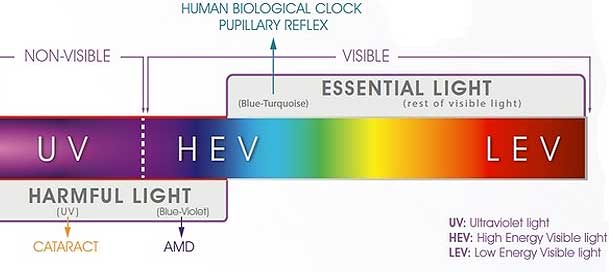
Artificial light sources can be very dangerous for your long term vision health.
The fluorescent lights in your office, the blue favoring lighting of many screens, and lots of other light sources can potential cause retinal damage in the short term, and macular degeneration in the long term.
This site is primarily intended to deal with myopia. It is the most prevalent of eye illnesses that have come to affect humanity only recently. However, there are a host of other eye health risks that our current environment creates for us.

Blue-Light Damage to the Rat Retina: Effect of Photoreversal of Bleaching
 Acute white-light damage to rods depends on the amount of rhodopsin available for bleaching during light exposure. Bleached rhodopsin is metabolically regenerated through the visual cycle involving the pigment epithelium, or photochemically by deep blue light through photoreversal of bleaching.”
Exposure to blue light resulted in severe retinal damage and activation of the transcription factor AP-1 in rats. In contrast, green light had no effect. When rhodopsin was almost completely bleached by short-term green-light exposure while metabolic regeneration (but not photoreversal) was prevented by halothane anesthesia, blue-light exposure induced distinct lesions in rat retinas.”
http://www.iovs.org/content/42/2/497.long
Blue Light Damage In The Retinal Pigment
A preliminary version of this paper was presented at the International Symposium on Retinal Degeneration, San Francisco, CA, 1988. The proceedings are to be published by Alan R. Liss, New York.
In order to elucidate the mechanisms of blue light damage on ocular tissues, the transepithelial transport, electrical characteristics and ultrastructural properties of irradiated isolated bovine retinal pigment epithelium (RPE) were investigated. Blue light (430 nm) irradiation at 20 mW/cm2 significantly reduced the transepithelial potential and short circuit current of RPE. During blue light exposure, a decrease in chloride transport was observed, and this decrease appeared to be closely coupled to changes in the electrical properties of the pigment epithelium. A decrease in leucine transport was also noted, but the effect required10–30 min of exposure to be manifested on some occasions. Utilizing the observed depolarizing effect of blue light, an action spectrum was determined which encompasses the absorption spectrum of the oxidized and reduced forms of cytochrome c oxidase. O2 uptake studies on isolated pigment epithelial cells verified the reduction of respiration by exposure to blue light, which is observed in other cells. Ultrastructural studies revealed that the major cytopathology observed up to 60 min after blue light exposure was a blistering of the mitochondria which progressed to a swollen, disrupted state within the post irradiation period of 1 h. Comparison of these results with those of other studies suggests that the mechanism of UV-A damage differs substantially from that of blue light.”
The problem with the blue light can not be fixed by buying some special computer glasses or sunglasses. Any products claiming otherwise are scientifically unproven, and highly suspect.
There is a very well written article on light sources, artificial light, and the blue light problem here, at preventblindness.org. Here is an excerpt for you:
Research continues to warn about the danger of sunlight to the eyes. Doctors wisely respond by recommending eye protection while outdoors during daylight. Curiously, however, some lighting manufacturers say lamps duplicating sunshine are good for vision and eye health. This presents a quandary that needs to be addressed.
Who is right? How does light hurt the retinas? What are the differences between fluorescent, halogen, neodymium, LED, and regular incandescent lightbulbs? What is meant by “full spectrum” and “daylight?” What kind of lighting is best and safest? Before approaching these questions, it is important to have a basic understanding of light and its effects on the retina.
Light is made up of electromagnetic particles that travel in waves. The human eye responds to only a small part of the entire electromagnetic spectrum. From the longest waves (lowest frequency) through the shortest waves (highest frequency), lighting specialists identify the electromagnetic wave regions as 1) radio waves, 2) microwaves and radar, 3) millimeter waves and telemetry, 4) infrared, 5) visible light, 6) ultraviolet, and 7) x-rays and gamma rays.

(Fig. 1)
As illustrated in Figure 1, the “visible light spectrum” is that small part of the electromagnetic wave spectrum seen as colors. The visible light spectrum ranges from about 700nm (nanometers) to about 400nm. In order, the colors are red, orange, yellow, green, blue, indigo, and violet. These are the colors of a rainbow from top to bottom, which can be remembered by the fictitious name ROY G BIV.
The retina is a very thin, multi-layered tissue located at the back of the eyeball. The lens at the front of the eyeball focuses light onto it.

(Fig. 2)
As shown in Figure 3, light first enters the optic (or nerve) fiber layer and the ganglion cell layer, under which most of the nourishing blood vessels of the retina are located. This is where the nerves begin, picking up the impulses from the retina and transmitting them to the brain.

(Fig. 3)
The light is received by photoreceptor cells called rods (responsible for peripheral and dim light vision) and cones (providing central, bright light, fine detail, and color vision). The photoreceptors convert light into nerve impulses, which are then processed by the retina and sent through nerve fibers to the brain.
Until recently, the rod and cone photoreceptor cells in the retinas have been credited with total responsibility for light sensitivity. Recent research, however, has shown that some of the ganglion cells may be performing as a third type of photoreceptor called “intrinsically photosensitive retinal ganglion cells” (ipRGC).1 2 These sparsely situated cells are most sensitive to blue light. They seem to exist principally to help differentiate between day and night (thus modulating the “sleep/wake” cycles, known as circadian rhythms). 3 4 5 The ipRGC have been shown to independently control dilation and contraction of the pupils, with a peak response at the blue light wavelength of 480nm. Some researchers have concluded through testing that the reaction of these ganglion cells is evidence of the importance of blue light to useable vision. An opposing view is that such experiments are actually measuring the subject’s psychological reaction to the apparent increase in the field of view caused by the contribution of the ipRGC. This, researchers say, may cause the subject to interpret the environment as “brighter.” Both sides agree that more study is needed before any definite conclusions can be drawn.
Sight requires light. As years go by, accumulation of lipofuscin (cellular debris) in the retinal pigment epithelium (RPE) may make the retina more sensitive to damage from chronic light exposure.6 7 8 9 10 11 12 13 14 15 Retinal light damage has been studied by exposing experimental animals and cell cultures to brilliant light exposures for minutes to hours. According to some of these studies,16 17 18 19 blue light waves may be especially toxic to those who are prone to macular problems due to genetics, nutrition, environment, health habits, and aging. On the other hand, acute retinal phototoxicity experiments such as these can cause retinal injuries, but they cannot simulate a lifetime of normal light exposure. Some researchers have noted strong similarities between photic injury and retinal abnormalities caused by years of overexposure to light.47 48 49 50 Others have found no similarities. 51 52 53 5455 56 57 58 Whereas the shorter wavelengths of UV-A and UV-B are somewhat filtered by the lens and cornea, animal studies have shown that the light spectrum from UV through blue can be harmful. During lengthy exposures of up to 12 hours, toxicity of the retina is known to increase as the light wavelengths grow shorter.20 2122 23 24 25 26 27 28 29 30 31 32 33 56 More recently, research on human fetal cell tissue has also revealed damage from blue light exposure.78 Fortunately, healthy retinas have a wide array of built-in chemical defenses against UV-blue light damage. They bear such imposing names as xanthophyll, melanin, superoxide dismutase, catalase, and glutathione peroxidase. And then there are the more familiar agents vitamin E, vitamin C, lutein, and zeaxanthin. 35 36 37 38 39 Unfortunately, these defenses can weaken with disease, injury, neglect, and age.
Another built-in protective process is that the natural lens takes on a yellowish tint with age, which helps to filter blue light.59 60 After cataract surgery, however, patients lose that benefit. Some doctors now recommend replacing the damaged lens with an intraocular lens (IOL) that is tinted to block blue light.79 The patient should be made aware, however, that this procedure will diminish scotopic (night) vision.6162
continued here …
—-
What can you do to protect your eyes, while still managing your day-to-day life?
Again, don’t believe any hype in special lenses. The last thing we need is more products to fix the problem caused by other products. We don’t need more man-made things to fix our body from damage created by man-made things.
Take small steps towards a healthier environment for yourself. Here are things I do, whenever I can:
Working Outdoors
When I have to work, but not necessarily in an office, I try to get my laptop outside. An outdoor cafe, the park, anywhere where I get natural lighting as my ambient light. I did invest in an Internet tethering setup (most smartphones can do that these days, feeding Wifi to your laptop). I bought a Macbook Air with a long lasting battery. Anytime I have to choice to work outdoors, I do.
Reading Outdoors
Likewise with reading. I try to avoid reading at night, replacing that time with podcasts that I can listen to, with my eye closed. Audio books might do it for you, as well.
When it is nice out, I grab a book and read it outside. Natural lighting, even if it’s just some of the time, is better than not at all. Whenever I get the choice of indoors vs. outdoors, or at least windows vs. fluorescents, I choose the more natural option. One might not want to go overboard, quit the job and move to the forest, but even small steps towards healthier environments make a real difference.
Less Night Time Computer Use
As I mentioned above, podcasts, audio books, anything other than adding hours and hours of screen time after dark, makes my list. There are many other benefits to this, for example you may notice that you sleep better as well.
Avoiding Hype
I get pitched products relatively frequently, often from well intentioned individuals. In India it might be acupuncture, in the U.S. it’s going to be eye vitamins, and in German it’s the latest light filtering coated lens. We go to such lengths to (poorly) emulate nature.
Can we just eat some fruits and vegetables, not grown by some giant GMO outfit, in questionable conditions? Can we go outside? Can we use less complex lens prescriptions? Maybe skip downloading that latest smartphone game, instead call a friend and go for a walk?
Modern life is fantastic. 3D and Holographic projection head gear, quantum dot TVs, and high speed Internet in your pocket. I look at all of it like one could look at drugs or alcohol (or cookies and cigarettes and roller coaster rides). Moderation is key. Just because there is TV and iPads, doesn’t mean we should replace our entire free time options with screens. It’s an effort, indeed. It seems easier and more fun to just sit on the couch and consume. But the price will be not seeing the world, which we choose to ignore in favor of screens. Ironic, perhaps.
Get yourself outside! ;-)
Cheers,
– Jake
Related: tetrachromacy, explained · contrast sensitivity, explained